

Many creditors and debt buyers will accept less than the full balance, especially on older or charged-off accounts. But settlement mistakes are common: paying before getting the deal in writing, giving a collector ongoing access to your bank account, or paying on a debt that was never verified.
A written offer protects you. Below is a free debt settlement letter template, along with guidance on choosing an offer, the terms to insist on, and how to pay safely.
Key Takeaways
- Verify the debt before offering to settle it, and check the statute of limitations.
- Make your offer in writing and get the creditor’s written acceptance before paying.
- The agreement should state that payment resolves the account in full and how it will be reported.
- Pay with a method you control, and keep proof forever.
Before You Offer: Four Checks
- Is the debt verified? Use the verification response checklist.
- Who owns it? Make sure you are dealing with the party that can settle it.
- Is it time-barred? A payment may revive an old debt in some states.
- Can you afford a lump sum? Lump sums usually get better terms than payment plans.
Choosing an Offer Amount
There is no fixed percentage. Creditors consider the age of the debt, who owns it, documentation strength, your hardship, and whether a lawsuit is pending. Debt buyers who paid a fraction of the balance often have more flexibility than original creditors. Start lower than your maximum to leave room to negotiate, and never offer more than you can actually pay.
The Template
[YOUR NAME]
[ADDRESS]
[DATE]
VIA CERTIFIED MAIL, RETURN RECEIPT REQUESTED
[CREDITOR/COLLECTOR NAME AND ADDRESS]
Re: Account/reference number [NUMBER]
Original creditor: [NAME]
To Whom It May Concern:
I am writing regarding the above account. Without admitting liability, and to resolve this matter, I am prepared to pay $[AMOUNT] as a one-time lump sum in full and final settlement of this account.
This offer is conditioned on your written agreement, before payment, to the following terms:
1. Payment of $[AMOUNT] will satisfy the account in full, and no further amounts will be sought by you or any assignee.
2. You will not sell, assign, or transfer any remaining balance.
3. You will report the account to all consumer reporting agencies to which you report as [“paid in full” / “settled for less than full balance” / deleted] within 30 days of receiving payment.
4. [If applicable] Any pending lawsuit will be dismissed with prejudice within [NUMBER] days of payment, with each party bearing its own costs.
If you accept, please send a signed written agreement on your letterhead reflecting these terms. Upon receipt, I will send payment by [cashier’s check / money order / one-time electronic payment] within [NUMBER] days.
This offer expires on [DATE]. This letter is not an acknowledgment of the debt or a promise to pay except as stated above, and it is made for settlement purposes only.
Sincerely,
[SIGNATURE]
[PRINTED NAME]
Terms to Require in Writing
| Term | Why it matters |
|---|---|
| “Settled in full” or “paid in full” language | Prevents later claims for the remaining balance |
| No resale of the balance | Prevents a new collector from pursuing the difference |
| Credit reporting terms | Clarifies how the account will appear; deletion is not guaranteed |
| Lawsuit dismissal (if sued) | Ends the case formally |
| Payment amount, method, and deadline | Avoids misunderstandings |
| Names of both parties and account numbers | Ties the agreement to the right debt |
Paying Safely
- Do not give ongoing access to your checking account.
- Use a cashier’s check, money order, or one-time payment you initiate.
- Pay only after receiving the signed agreement.
- Keep copies of the agreement, the payment, and the delivery confirmation permanently.
- Check your credit reports 30 to 60 days later to confirm the agreed reporting.
Credit Reporting: Paid vs. Settled vs. Deleted
A settled account typically shows as “settled for less than full balance.” Some creditors will agree to report “paid in full” or to delete the account, but many will not. Read more about pay for delete and its limits.
Taxes on Forgiven Debt
If a creditor forgives $600 or more, it may send you a Form 1099-C. The forgiven amount may be taxable unless an exclusion applies, such as insolvency. Use the insolvency worksheet to evaluate your situation, and talk to a tax professional.
Example: Getting It in Writing First
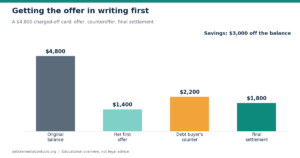
A hypothetical consumer owes a debt buyer $4,800 on a charged-off card that she has verified. She sends this template offering $1,400 as a lump sum. The debt buyer counters at $2,200. She replies offering $1,800, and the debt buyer accepts, sending a signed letter stating the account will be satisfied in full, not resold, and reported as settled.
She pays with a cashier’s check sent by certified mail and saves everything in her file. Eighteen months later, a different company contacts her about the same account. She sends a copy of the settlement agreement and proof of payment, and the new company closes its file within a week.
Where This Letter Fits in Your Workflow
- Before: Verify the debt with a validation letter and check ownership; confirm it is not time-barred with the statute of limitations worksheet.
- Alongside: Build the settlement amount into your budget and save in a separate account.
- After: Store the signed agreement and proof of payment in your document system, and check credit reports in 30 to 60 days.
- At tax time: If you receive a 1099-C, complete the insolvency worksheet.
Quick-Use Checklist
- ☐ Debt verified and owner confirmed
- ☐ Offer amount affordable as a lump sum
- ☐ “Paid/settled in full” and no-resale language required
- ☐ Credit reporting terms specified
- ☐ Signed acceptance received before payment
- ☐ Paid by a one-time method you control
Frequently Asked Questions
You can negotiate by phone, but confirm every term in writing before paying. Written offers create a clear record.
Yes. Make sure the agreement includes dismissal of the case, and confirm the dismissal is filed with the court.
Do not pay. A legitimate collector should confirm a settlement in writing.
It can be, but it carries more risk: if you miss a payment, the agreement may be voided. Get the terms, including what happens on a missed payment, in writing.
Settle on Your Terms
Debt Remediation Tools from Foxboro Consulting Group, Inc. includes this settlement letter, counteroffer templates, and a settlement tracking sheet to help you resolve debts safely.
Ready to make an offer? Verify the debt, personalize this template, and get it in writing before you pay.
Disclaimer: Templates and tools in this article are provided for general educational purposes and are not legal advice. Adapt every letter to your own facts, keep copies of everything you send, and consult a licensed attorney in your state before responding to a lawsuit or court deadline.


1 Comment
Statute of Limitations Debt Worksheet & Calculator Guide
[…] After: If the debt appears time-barred, respond with the time-barred debt letter. If it is within the period, consider verification and a written settlement offer. […]