


You missed a payment during a hard month: a medical emergency, a job change, a mix-up with autopay. Now that late payment sits on your credit report, dragging down your score. If the information is accurate, you cannot force the creditor to remove it through a dispute. But you can ask.
A goodwill letter is a polite request asking a creditor to remove an accurate negative mark as a courtesy. It does not always work, but it costs nothing, and when it works, it can make a real difference. Below is a free template and tips for success.
Key Takeaways
- A goodwill letter asks for a courtesy; creditors are not required to agree.
- It works best for isolated late payments by customers with otherwise good history.
- Be honest, brief, and specific about what happened and what has changed.
- If the information is inaccurate, use a dispute instead of a goodwill letter.
Goodwill Letter vs. Dispute
| Goodwill letter | Credit dispute | |
|---|---|---|
| Information is | Accurate | Inaccurate or incomplete |
| Legal right? | No, a courtesy request | Yes, under the FCRA |
| Sent to | The creditor | Credit bureaus and/or the furnisher |
| Best for | Isolated late payments, paid accounts | Errors, wrong dates, accounts not yours |
For errors, use the credit dispute letter template.
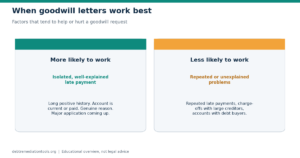
When Goodwill Letters Work Best
- The late payment was a one-time event
- You have a long, otherwise positive history with the creditor
- The account is current or paid in full
- There was a genuine reason, such as hospitalization, a natural disaster, or an autopay error
- You are preparing for a major application, such as a mortgage
They are less likely to work for repeated late payments, charge-offs with large creditors, or accounts in collection with debt buyers.
The Template
[YOUR NAME]
[ADDRESS]
[DATE]
[CREDITOR NAME]
[CUSTOMER SERVICE OR EXECUTIVE OFFICE ADDRESS]
Re: Account ending in [LAST FOUR DIGITS]
Dear [NAME OR “Customer Relations Team”]:
I have been a customer since [YEAR] and have valued my account with you. I am writing to ask for a goodwill adjustment to my credit reporting.
In [MONTH YEAR], my payment was reported [30/60] days late. This happened because [BRIEF, HONEST EXPLANATION, e.g., I was hospitalized for two weeks and missed the due date]. Since then, I have [e.g., set up automatic payments and paid on time every month for the past 18 months].
I take my obligations seriously, and this late payment does not reflect my overall history with you. I am [e.g., preparing to apply for a mortgage], and this entry is affecting my ability to qualify for favorable terms.
I respectfully ask that you consider removing the late payment from my credit reports as a gesture of goodwill.
Thank you for your time and consideration.
Sincerely,
[SIGNATURE]
[PRINTED NAME]
[PHONE / EMAIL]
Tips for Success
- Keep it short. One page is plenty.
- Be honest. Do not exaggerate or invent circumstances.
- Show what has changed. Autopay, a new job, recovery from illness.
- Be polite and personal. Address a real person if possible.
- Try more than one channel. Customer service, the executive office, or a secure message through your online account.
- Follow up. If you do not hear back in a few weeks, send a polite follow-up or try another department.
- Do not threaten. Goodwill is a request, not a demand.
Goodwill Letters After Paying Collections or Settlements
Goodwill letters are sometimes used after paying off a collection account. Results vary widely. Some smaller collectors and original creditors agree; many large debt buyers have policies against removing accurate information. If you are still negotiating, consider making deletion part of a written settlement offer using the debt settlement letter template.
What to Do If the Creditor Says No
- Thank them and ask whether they would reconsider after more months of on-time payments
- Focus on building positive history; see rebuild credit after debt
- Remember that negative items lose impact over time and must be removed at the end of the reporting period
Example: The Autopay Mix-Up
A hypothetical consumer with a ten-year perfect record on her auto loan changes banks and forgets to update her autopay. The next payment is reported 30 days late. She pays immediately and has paid on time for the following 14 months.
Preparing to refinance her home, she sends this goodwill letter to the lender’s customer relations department, explaining the bank change and attaching proof of her new autopay setup. Three weeks later, the lender agrees to request removal of the late payment from all three bureaus. Her score improves, and she qualifies for a better refinance rate.
Where This Letter Fits in Your Workflow
- Before: Confirm the late payment is accurate. If it is wrong, use the credit dispute letter instead.
- Alongside: Set up autopay or alerts so you can show the problem will not recur.
- After: If the creditor declines, keep building positive history and try again after more on-time months.
- For collection accounts: Consider negotiating reporting terms in a written settlement offer.
Quick-Use Checklist
- ☐ Account is current or paid
- ☐ Explanation is honest and brief
- ☐ Positive history and changes highlighted
- ☐ Addressed to a real department or person
- ☐ Follow-up planned in three to four weeks
- ☐ Credit reports checked after any approval
Frequently Asked Questions
Creditors have discretion over what they report, though they must report accurately. Some agree to goodwill adjustments; many have policies limiting them.
Many consumers wait until they have several months of on-time payments to show improvement, but there is no fixed rule.
Goodwill requests go to the creditor, which controls what it reports. Bureaus only investigate inaccuracies.
You can try more than once, especially after more on-time payments, but keep requests respectful.
Ask the Right Way
Debt Remediation Tools from Foxboro Consulting Group, Inc. includes goodwill, settlement, and dispute templates so you can choose the right letter for every credit reporting situation.
Have one late payment holding you back? Personalize this template and send it today.
Disclaimer: Templates and tools in this article are provided for general educational purposes and are not legal advice. Adapt every letter to your own facts, keep copies of everything you send, and consult a licensed attorney in your state before responding to a lawsuit or court deadline.