

When a debt collector crosses the line, your word against theirs is not enough. What makes the difference in a complaint, a negotiation, or a lawsuit is a detailed, contemporaneous record. A debt collector call log turns every call, voicemail, text, and email into organized evidence.
This guide gives you a ready-to-use call log template, explains what to record, and shows how to spot violations using the data you collect.
Key Takeaways
- Record every contact the same day: date, time, caller, number, method, and what was said.
- Logs help you identify patterns, such as more than seven calls in seven days about one debt.
- Save voicemails, screenshots, and letters alongside your log.
- A good log supports complaints to regulators and claims under the FDCPA.
What to Record for Every Contact
| Field | Example |
|---|---|
| Date | 03/14/2026 |
| Time | 8:42 a.m. |
| Method | Call / voicemail / text / email / letter / social media |
| Incoming or outgoing | Incoming |
| Phone number or address | (555) 010-0100 |
| Company | ABC Recovery Services |
| Representative’s name | “Mike” |
| Account or reference number | 123456 |
| Debt discussed | Store card, original creditor XYZ Bank |
| What was said | Asked for payment of $1,850 today; said “we’ll garnish your wages next week” |
| Your response | Requested written communication only |
| Threats or unusual statements | Garnishment threat (no lawsuit known) |
| Evidence saved | Voicemail saved; screenshot of call log |
| Follow-up needed | Send written-only letter; check court records |
The Template
DEBT COLLECTOR CONTACT LOG
Name: [YOUR NAME] Month/Year: [MONTH YEAR]
Entry #: ___
Date: ___________ Time: _______ Method: Call / VM / Text / Email / Letter / Other
Direction: Incoming / Outgoing
Number or address used: _______________________
Company: _______________________ Rep name/ID: ______________
Account/ref #: ________________ Original creditor: ______________
Summary of what was said:
______________________________________________________________
Threats, false statements, or rude language (quote exactly):
______________________________________________________________
My response / requests made:
______________________________________________________________
Was this contact at work or an inconvenient time? Y / N
Calls about this debt in the last 7 days (including this one): ____
Evidence saved (voicemail, screenshot, letter): ________________
Follow-up action and date: _____________________________________
Print several copies or recreate the fields in a spreadsheet so you can sort and count entries.
Using Your Log to Spot Violations
Call Frequency (Regulation F)
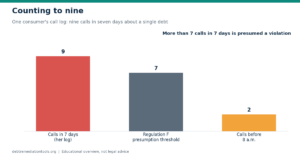
A debt collector is presumed to violate the law if it places more than seven calls within seven consecutive days about a particular debt, or calls within seven days after a phone conversation about that debt. Your “calls in last 7 days” column makes this easy to check.
Inconvenient Times and Places
Calls before 8 a.m. or after 9 p.m. your local time, or calls at work after you said they are not allowed, may violate the FDCPA.
Contact After a Cease Request
If you sent a cease and desist letter, log the delivery date. Any contact afterward, beyond the legal exceptions, is significant.
Threats and False Statements
Quote exactly. Threats of arrest, garnishment without a judgment, or lawsuits on time-barred debts may be violations.
Third-Party Contacts
Note if collectors discuss your debt with family, neighbors, or your employer.
Learn more about the rules in our Regulation F guide.
Preserving Evidence
- Voicemails: Save and back them up to cloud storage or email them to yourself.
- Call history: Take screenshots showing dates, times, and numbers.
- Texts and emails: Screenshot with dates and sender details visible.
- Letters: Keep originals and envelopes.
- Recordings: Check your state’s law first. Massachusetts, for example, generally requires all parties’ consent to record a conversation.
How Your Log Gets Used
- Complaints: Attach a summary to complaints filed with the CFPB, FTC, or your state attorney general. See how to file a complaint against a debt collector.
- Negotiation: Documented violations can change a collector’s willingness to settle.
- Legal claims: Consumer attorneys use logs to evaluate FDCPA claims, which generally must be filed within one year of the violation.
- Court defense: If you are sued, your records help your attorney.
Example: Counting to Nine
A hypothetical consumer logs every call from one collector over two weeks. Her log shows nine calls between Monday and the following Sunday about a single debt, two calls before 8 a.m., and a voicemail stating she “could be arrested” if she did not pay.
She sends a written-only communication letter, files a CFPB complaint attaching a one-page summary of her log and the saved voicemail, and consults a consumer attorney. The calls stop, and the attorney pursues an FDCPA claim. Her careful entries made the pattern undeniable.
Where This Log Fits in Your Workflow
- Before: Set up your debt tracker so each log entry can be tied to a specific debt.
- Alongside: When patterns appear, send a written-only or cease and desist letter and log the delivery date.
- After: Summarize violations for a regulator using the complaint guide, or share the log with a consumer attorney.
Quick-Use Checklist
- ☐ Every call, voicemail, text, and email logged the same day
- ☐ Exact quotes recorded for threats or false statements
- ☐ Seven-day call count updated per debt
- ☐ Voicemails and screenshots backed up
- ☐ Work calls and inconvenient times flagged
- ☐ Monthly review for patterns
Frequently Asked Questions
Yes. Missed calls and voicemails count as contacts and are part of the pattern.
Yes. The FDCPA may not apply, but state laws, such as Massachusetts regulations limiting creditor calls, may.
At least until the debt is fully resolved and any deadlines for claims have passed. Many people keep them indefinitely.
Yes. A spreadsheet makes counting and sorting easier. Just make entries promptly.
Document, Then Decide
Debt Remediation Tools from Foxboro Consulting Group, Inc. includes printable and spreadsheet versions of this call log, along with complaint summaries and follow-up letter templates.
Collectors calling nonstop? Start your log today, beginning with the next call.
Disclaimer: Templates and tools in this article are provided for general educational purposes and are not legal advice. Adapt every letter to your own facts, keep copies of everything you send, and consult a licensed attorney in your state before responding to a lawsuit or court deadline.


1 Comment
Debt Tracker Spreadsheet Template: Organize Every Debt
[…] Alongside: Link each row to a folder in your document system and to your call log. […]