

Key takeaways
- Credit card minimum payments are designed to keep your account current, not to pay off your balance quickly.
- In our example, a $6,000 balance at 22.99% APR paid with minimum payments only would take about 18 years and cost nearly $10,000 in interest.
- Switching to a fixed $250 monthly payment pays it off in 33 months with about $2,113 in interest, saving nearly $7,900.
- Your credit card statement includes a minimum payment warning showing how long payoff will take at the minimum. Read it.
- The key to escaping the minimum payment trap is a fixed payment that doesn’t shrink as your balance falls.
Your credit card statement arrives with a balance of $6,000 and a minimum payment of about $175. Paying $175 feels manageable. It keeps the account current and protects your credit.
But here’s what the minimum doesn’t show you on the front page: if you keep paying only the minimum, you’ll likely be making payments for well over a decade, and you could pay more in interest than you originally borrowed.
This guide explains how minimum payments work, shows the math with real examples, and explains how to break the cycle.
How credit card minimum payments are calculated
Each card issuer sets its own formula, disclosed in your cardholder agreement. Common formulas include:
- A percentage of the balance plus interest and fees, such as 1% of the balance + that month’s interest + any fees; or
- A flat percentage of the balance, such as 2% or 3%;
- with a minimum floor, such as $25 or $35, or the full balance if it’s less than the floor.
Because most formulas are tied to your balance, the minimum payment falls as your balance falls. That sounds helpful, but it’s exactly why minimum payments take so long: as your payment shrinks, more of each payment goes to interest and less to principal.
The example: $6,000 at 22.99% APR
Assumptions:
- Starting balance: $6,000
- APR: 22.99% (interest calculated monthly)
- Minimum payment formula: 1% of balance + monthly interest, minimum $35
- No new purchases, fees or rate changes
Your first minimum payment
- Monthly interest: $6,000 × 22.99% ÷ 12 = $114.95
- 1% of balance: $60.00
- First minimum payment: $174.95
Only $60 of that first payment reduces your balance. The other $114.95 is interest.
Paying the minimum vs. a fixed payment
| Strategy | Time to pay off | Total interest |
|---|---|---|
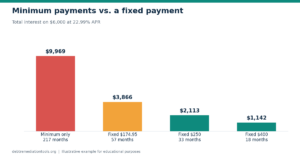
| Minimum payment only | About 217 months (18 years) | About $9,969 |
| Fixed $174.95 (first minimum, never reduced) | 57 months | About $3,866 |
| Fixed $250 per month | 33 months | About $2,113 |
| Fixed $400 per month | 18 months | About $1,142 |
Paying a fixed $250 a month, only about $75 more than the first minimum payment, cuts the payoff time by more than 15 years and saves nearly $7,900 in interest.
Paying $400 a month saves even more and finishes in a year and a half.
Why “fixed” is the magic word
Look at what happens if you start at the minimum ($174.95) but keep paying that same amount every month instead of letting it drop. Because the payment no longer shrinks as the balance falls, more and more of each payment goes to principal. In our example, simply locking in that first minimum of $174.95 pays the card off in about 57 months (under five years) with about $3,866 in interest, instead of 18 years and nearly $10,000.
Rule of thumb: Decide on a fixed monthly payment you can sustain, set it up as an automatic payment, and never let it drop until the card is paid off.
Read your statement’s minimum payment warning
Under the federal Credit CARD Act of 2009, credit card statements must include a minimum payment warning showing:
- how long it will take to pay off your balance if you make only minimum payments
- the total cost (principal plus interest) of paying only the minimum
- the monthly payment needed to pay off the balance in three years, and the total cost of that approach
- a toll-free number for credit counseling information
That three-year payment is a useful benchmark. If you can afford it, you’ll be debt-free on that card in 36 months.
What makes payoff slower
- New purchases on the card;
- Rate increases, including penalty APRs after late payments;
- Fees such as late fees and over-limit fees;
- Cash advances, which often carry higher rates and no grace period; and
- Deferred interest promotions that expire with the full balance unpaid.
Strategies to pay off credit cards faster
1. Set a fixed payment
Choose an amount that pays off the card within a target time, such as two or three years, and automate it.
2. Stop adding new charges
Move recurring charges to a debit card or a card you pay in full monthly.
3. Prioritize with a plan
If you have multiple cards, use the debt avalanche (highest rate first) or debt snowball (smallest balance first). See our side-by-side snowball vs. avalanche example.
4. Lower your interest rate
- Call your issuer and ask for a lower APR, especially if you have a good payment history.
- Consider a balance transfer to a 0% promotional card. Run the numbers, including fees, with our balance transfer calculator guide.
- Consider a consolidation loan with a lower fixed rate.
5. Find extra money
Even $50 more per month makes a measurable difference. Our budget for debt payoff guide shows where to look.
6. Make payments before the statement closes
Paying before the statement closing date can lower the balance reported to credit bureaus, which can improve your credit utilization.
What if you can’t afford more than the minimum?
If even minimum payments are a struggle:
- contact your card issuer about hardship programs, which may temporarily reduce your rate or payment
- consider a nonprofit credit counseling agency about a debt management plan
- if accounts have gone to collections, learn your rights before paying. Our sister site, Debt Remediation, explains how to validate debts and handle collectors
Frequently asked questions
Paying at least the minimum on time keeps your account in good standing, which helps your payment history. But carrying high balances increases your credit utilization, which can lower your score.
Most cards use an average daily balance method with a daily periodic rate (APR ÷ 365). For simplicity, our examples use a monthly rate (APR ÷ 12), which produces similar results.
Under the CARD Act, amounts above the minimum are generally applied to the balance with the highest interest rate first, which helps you save money.
Paying minimums on all and focusing extra money on one target card is usually most effective.
Run your own numbers
Every card is different. Enter your balance, APR and minimum payment formula into our free debt payoff calculator to see how long payoff will take at the minimum, and how much faster you’ll be debt-free with a fixed payment.
This article is for general educational purposes and is not financial advice. Examples are illustrative, based on simplified assumptions; actual results depend on your card’s terms.