

Key takeaways
- Every successful debt payoff plan runs on a budget. The budget is where the extra money for debt actually comes from.
- The 50/30/20 method is simple: 50% of take-home pay for needs, 30% for wants, 20% for savings and extra debt payments.
- The zero-based method assigns every dollar a job until income minus spending equals zero. It’s more detailed and often finds more money for debt.
- Plan for irregular expenses (car repairs, annual bills, holidays) with sinking funds, or they’ll derail your plan.
- The best budget is one you review regularly and adjust. Expect the first month to be imperfect.
“I just need to make more money” is a common reaction when debt feels overwhelming. Sometimes that’s true. But for most people, the first and fastest step is understanding where current money goes, and redirecting some of it toward debt.
That’s what a budget does. Not a punishment or a straitjacket, but a plan that tells your money where to go instead of wondering where it went.
This guide covers two proven budgeting methods, a sample debt payoff budget, and practical ways to find extra money.
Step 1: Know your take-home pay
Start with net monthly income, the amount that actually lands in your bank account after taxes, retirement contributions and benefits.
- If you’re paid biweekly, multiply one paycheck by 26 and divide by 12. (Or budget using two paychecks per month, and treat the two “extra” paychecks each year as a bonus for debt.)
- If your income varies, budget based on your lowest typical month, and send extra income to debt or savings when it comes.
Step 2: List every debt
Before you budget, know exactly what you owe. Use our debt inventory worksheet to record each debt’s balance, interest rate, minimum payment and due date.
Step 3: Track your spending
Review the last two to three months of bank and credit card statements. Categorize every expense. Many people are surprised by:
- food delivery and dining out
- subscriptions they forgot about
- convenience purchases
- fees (bank fees, late fees, ATM fees)
Step 4: Choose a budgeting method
Method A: The 50/30/20 budget
Divide take-home pay into three buckets:
| Bucket | Share | Includes |
|---|---|---|
| Needs | 50% | Housing, utilities, groceries, transportation, insurance, minimum debt payments, childcare |
| Wants | 30% | Dining out, entertainment, subscriptions, travel, shopping |
| Savings and extra debt payments | 20% | Emergency fund, retirement, payments above minimums |
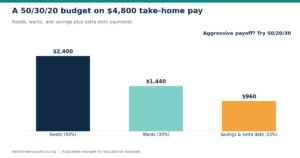
Example with $4,800 monthly take-home pay:
- Needs: $2,400
- Wants: $1,440
- Savings and extra debt: $960
For aggressive debt payoff, many people temporarily shift the split toward something like 50/20/30, cutting wants to put more toward debt.
Pros: simple, flexible, easy to maintain. Cons: if needs exceed 50% (common in high-cost areas), the method requires adjustment.
Method B: The zero-based budget
Income − Planned spending, saving and debt payments = $0
Every dollar is assigned a job before the month begins. “Zero” doesn’t mean your bank account is empty; it means no money is unassigned.
Sample zero-based budget ($4,800 take-home):
| Category | Amount |
|---|---|
| Rent | $1,550 |
| Utilities and internet | $210 |
| Phone | $65 |
| Groceries | $520 |
| Transportation (gas, insurance, maintenance) | $380 |
| Health insurance and medical | $160 |
| Childcare | $0 |
| Minimum debt payments | $455 |
| Extra debt payment | $500 |
| Emergency fund | $150 |
| Sinking funds (car repairs, gifts, annual bills) | $200 |
| Retirement (beyond payroll deductions) | $0 |
| Dining out and entertainment | $250 |
| Personal care and household | $120 |
| Subscriptions | $40 |
| Clothing | $80 |
| Miscellaneous buffer | $120 |
| Total | $4,800 |
| Remaining | $0 |
Pros: intentional, often finds more money for debt. Cons: more time-consuming, especially at first.
Other approaches
- Envelope method: Cash (or digital “envelopes”) for variable categories like groceries and entertainment. When the envelope is empty, spending stops.
- Pay yourself first: Automatically move money to savings and extra debt payments on payday, then spend what’s left.
Step 5: Plan for irregular expenses with sinking funds
Budgets often fail because of expenses that don’t happen every month:
- car repairs and registration
- annual insurance premiums
- holidays and birthdays
- back-to-school costs
- medical deductibles
- home maintenance
A sinking fund sets aside a monthly amount for each. For example, $1,200 of holiday spending becomes $100 a month. When the expense arrives, the money is waiting, and you don’t reach for a credit card.
Step 6: Find extra money for debt
Small changes add up. Some common sources:
| Change | Possible monthly savings |
|---|---|
| Cancel unused subscriptions | $20 to $60 |
| Switch to a lower-cost phone plan | $20 to $50 |
| Shop insurance (auto, home, renters) | varies |
| Cook more meals at home | $100 to $300 |
| Reduce impulse purchases with a 48-hour rule | varies |
| Sell unused items | one-time cash |
| Pick up extra hours or side income | varies |
Even $100 extra per month on a credit card can cut years off payoff. See the math in our guide to the true cost of minimum payments.
Step 7: Choose a payoff strategy
With your extra debt payment set, choose an order: the debt snowball (smallest balance first) or debt avalanche (highest interest first). Our side-by-side example shows how they compare.
Step 8: Protect the plan with an emergency fund
A small emergency fund keeps an unexpected expense from becoming new debt. See our guide to the emergency fund vs. debt payoff.
Step 9: Review weekly, adjust monthly
- Weekly: check spending against the plan (10 minutes).
- Monthly: compare actual vs. budget, adjust categories and plan next month.
- Quarterly: update your debt list and net worth statement to see progress.
Common budgeting mistakes
- Being too strict. A budget with no room for fun rarely lasts.
- Forgetting irregular expenses.
- Not tracking spending after creating the budget.
- Giving up after one bad month.
- Not involving a partner in household budgeting.
- Budgeting with gross income instead of take-home pay.
When the numbers don’t work
If your essential expenses and minimum payments exceed your income, a budget alone may not be enough. Consider:
- contacting creditors about hardship programs
- speaking with a nonprofit credit counselor
- reviewing whether debts in collections are accurate before paying them (our sister site, Debt Remediation, explains how)
- getting professional advice about your options
Frequently asked questions
The one you’ll stick with. Zero-based budgets tend to find more money for debt; 50/30/20 is easier to maintain.
Minimum payments plus as much extra as your budget allows while still covering essentials and a small emergency fund. Many people aim for 15% to 20% or more of take-home pay during an aggressive payoff phase.
Most people budget monthly but check spending weekly.
Budget based on your lowest typical month and use higher-income months to build savings and pay extra on debt.
Build your budget now
Use our free budget template and calculators to set up your categories, plan your extra debt payment and see your debt-free date. Then enter that extra payment into our free debt payoff calculator to see how fast you can be debt-free.
This article is for general educational purposes and is not financial advice.