


Key takeaways
- A balance transfer moves high-interest credit card debt to a card with a low or 0% promotional APR, usually for 12 to 21 months.
- Most transfers charge a fee of about 3% to 5% of the amount transferred, added to your balance.
- In our example, transferring $8,000 from a 24% card to a 0% card with a 3% fee saved about $1,742 in interest, as long as the balance was paid off on schedule.
- The key number is the monthly payment needed to clear the balance before the promotion ends: total transferred balance (including fee) ÷ number of promo months.
- Balance transfers work best when you stop adding new debt and have a realistic plan to pay off the balance during the promo period.
A 0% balance transfer offer can feel like a lifeline when you’re carrying high-interest credit card debt. Instead of paying 20% to 30% interest, you could pay nothing for a year or more and put every dollar toward the balance.
But a balance transfer isn’t free money. There’s usually an upfront fee, a deadline, and a higher rate waiting at the end. Whether it saves you money depends on the math, and on what you do after the transfer.
This guide shows how to calculate the real savings.
How a balance transfer works
- You apply for a card offering a promotional APR on balance transfers.
- If approved, you request a transfer of a balance from another card (usually from a different issuer; most issuers won’t let you transfer between their own cards).
- The new card pays off the old balance and adds that amount, plus a transfer fee, to your new account.
- You pay little or no interest during the promotional period.
- When the promotion ends, any remaining balance is charged the card’s regular APR.
The three numbers that matter
- Transfer fee: commonly 3% to 5% of the amount transferred, sometimes with a minimum dollar amount.
- Promotional period: how many months the low rate lasts.
- Go-to APR: the rate after the promotion ends.
The example
Sam has $8,000 on a card charging 24% APR and can afford to pay $450 per month.
Option A: Keep the balance where it is
At 24% APR and $450 per month:
- Payoff time: 23 months
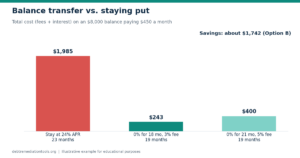
- Total interest: about $1,985
Option B: Transfer to a 0% card for 18 months with a 3% fee
- Transfer fee: $8,000 × 3% = $240
- New balance: $8,240
- At $450 per month, the balance is paid off in 19 months. Nearly all of it is paid during the 0% period, with only a few dollars of interest after the promotion ends.
- Total cost (fee + interest): about $243
Savings vs. Option A: about $1,742
Option C: Transfer to a 0% card for 21 months with a 5% fee
- Transfer fee: $8,000 × 5% = $400
- New balance: $8,400
- At $450 per month, paid off in 19 months, entirely within the promotion.
- Total cost: $400
Savings vs. Option A: about $1,585
Summary
| Option A: Stay at 24% | Option B: 0% for 18 mo, 3% fee | Option C: 0% for 21 mo, 5% fee | |
|---|---|---|---|
| Upfront fee | $0 | $240 | $400 |
| Interest paid | $1,985 | about $3 | $0 |
| Total cost | $1,985 | $243 | $400 |
| Months to pay off | 23 | 19 | 19 |
| Savings vs. A | about $1,742 | about $1,585 |
In this case, the lower fee beats the longer promotion, because Sam can pay the balance off within 18 months either way. If Sam could only afford a smaller payment, the longer promotion might win.
The payment that matters most
To pay off the entire balance before the promotion ends:
Required monthly payment = (Transferred balance + fee) ÷ Promotional months
For Option B: $8,240 ÷ 18 = $457.78 per month.
Sam’s $450 payment leaves a small balance at the end of month 18. Paying just $8 more each month would clear it entirely at 0%.
What happens if you only pay the minimum?
Suppose Sam transfers the balance but pays only $200 a month. After 18 months, Sam has paid $3,600, and $4,640 remains, now charged the card’s regular APR, which could be 24% or higher. The transfer still saved interest during the promo period, but Sam is back where the problem started, with a large high-interest balance.
A balance transfer works only if it’s paired with a payoff plan.
Watch out for these traps
1. New purchases on the transfer card
The promotional rate may apply only to transferred balances. New purchases could accrue interest at the regular rate. And under federal rules, payments above the minimum are generally applied to the balance with the highest rate first, but the minimum payment itself may be applied to the low-rate balance. Keep the transfer card for the transfer only.
2. Late payments
A late payment can trigger a penalty APR or end the promotional rate, depending on the card’s terms. Set up autopay.
3. Deferred interest vs. 0% APR
Some store cards and financing offers use deferred interest: if the balance isn’t paid in full by the end of the promotion, interest is charged retroactively from the date of purchase. True 0% balance transfer cards typically charge interest only on the balance remaining after the promotion. Read the terms carefully.
4. Credit limit shortfalls
You may be approved for a lower limit than you need. The fee also counts against the limit. Plan for the possibility that only part of your debt can be transferred.
5. Credit score effects
- A new application usually causes a hard inquiry and lowers your average account age, which may lower your score slightly in the short term.
- A large balance on a new card can raise per-card utilization.
- Over time, paying down the balance lowers utilization and can improve your score. See our guide to credit utilization.
6. Closing the old card
Closing the old card reduces your available credit and can raise utilization. Consider keeping it open (and unused) unless it has an annual fee.
Balance transfer vs. personal loan
| Balance transfer | Personal (consolidation) loan | |
|---|---|---|
| Interest | 0% during promo, then regular APR | Fixed rate for the whole term |
| Fees | Transfer fee (3% to 5%) | Possible origination fee |
| Payment | Flexible (minimum required) | Fixed monthly payment |
| Best for | Balances you can pay off during the promo | Larger balances needing a longer structured payoff |
| Risk | Promo ends with balance remaining | Longer term may increase total interest |
Compare the numbers with our debt consolidation loan calculator guide or our free debt consolidation calculator.
Is a balance transfer right for you?
A balance transfer is likely worth it if:
- your current rate is high
- you qualify for a long 0% promotion with a reasonable fee
- you can pay off most or all of the balance during the promotion
- you’ll stop adding new debt
It may not be worth it if:
- the fee is high relative to the interest you’d save
- you can’t realistically pay down the balance during the promotion
- you’re likely to keep using the old card
Frequently asked questions
Often yes, if your current rate is high. On $8,000 at 24%, a 3% fee ($240) is far less than the roughly $1,985 in interest you’d otherwise pay over about two years.
Usually not. Most issuers only allow transfers from other issuers’ cards.
Any remaining balance is charged the card’s regular APR going forward.
It may cause a small temporary dip from the hard inquiry and new account, but paying down the debt can improve your score over time.
Run your own numbers
Enter your balance, current APR, transfer fee, promo length and monthly payment into our free balance transfer calculator to see your total cost and the payment needed to finish before the promotion ends. You can also see how a faster payment changes your timeline with our free debt payoff calculator.
This article is for general educational purposes and is not financial advice. Card terms vary; read your cardholder agreement. Examples are illustrative.