
Key takeaways
- A debt consolidation loan replaces several debts, usually credit cards, with one fixed-rate loan and one monthly payment.
- To compare offers, look at the APR, not just the interest rate. APR includes origination fees and reflects the true cost of borrowing.
- A lower monthly payment doesn’t always mean you save money. A longer term can increase total interest.
- In our example, consolidating $15,000 of 23% credit card debt into a 48-month loan at 13.9% with a 5% origination fee lowered the payment by about $69 a month and saved about $1,860. Paying the same $500 a month toward the loan would have saved about $2,760 and finished six months sooner.
- Consolidation works only if you stop running up the old cards.
Juggling several credit card bills, each with a different due date and a high interest rate, is exhausting. A debt consolidation loan promises simplicity: one payment, one fixed rate, one payoff date.
It can be a smart move. It can also cost you more if the fees are high, the term is long, or the old cards get used again. This guide shows how to compare consolidation offers using the numbers that matter.
How a debt consolidation loan works
- You borrow a fixed amount, usually through a personal loan from a bank, credit union or online lender.
- You use the proceeds to pay off your existing debts (some lenders pay creditors directly).
- You repay the new loan in fixed monthly payments over a set term, often two to seven years.
Interest rate vs. APR
- The interest rate is the cost of borrowing the principal.
- The APR (annual percentage rate) includes the interest rate plus certain fees, such as an origination fee, expressed as a yearly rate. Under the Truth in Lending Act, lenders must disclose the APR.
Origination fees commonly range from 0% to around 10% of the loan amount, depending on the lender and your credit. They’re often deducted from the loan proceeds, which means you may need to borrow more than you owe to pay off your debts in full.
The example
Alex has $15,000 in credit card debt at an average APR of 23% and has been paying $500 per month.
Option 1: Keep paying the cards
At $500 per month:
- Payoff time: 46 months
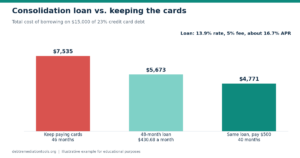
- Total interest: about $7,535
Option 2: 48-month consolidation loan at 13.9% with a 5% origination fee
Because the 5% fee is deducted from the proceeds, Alex must borrow about $15,789 to receive $15,000.
- Monthly payment: about $430.68
- Total of payments: about $20,673
- Total cost of borrowing (interest + fee): about $5,673
- APR: about 16.7% (higher than the 13.9% interest rate because of the fee)
Comparing the options
| Keep paying cards | Consolidation loan (48 months) | Consolidation loan, paying $500/mo | |
|---|---|---|---|
| Monthly payment | $500 | $430.68 | $500 |
| Months to pay off | 46 | 48 | 40 |
| Total cost of borrowing | about $7,535 | about $5,673 | about $4,771 |
| Savings vs. cards | about $1,863 | about $2,764 |
What this shows:
- The loan saves money even with a 5% fee because the interest rate is much lower
- The lower monthly payment comes with a slightly longer payoff
- If Alex keeps paying $500 a month toward the loan, Alex pays it off in 40 months and saves even more
How the term changes total cost
Same loan amount (about $15,789), same 13.9% rate:
| Term | Monthly payment | Total cost of borrowing (vs. $15,000 received) |
|---|---|---|
| 36 months | about $539 | about $4,400 |
| 48 months | about $431 | about $5,673 |
| 60 months | about $367 | about $6,995 |
A 60-month loan has the lowest payment but costs about $2,600 more than the 36-month loan. Choose the shortest term you can comfortably afford.
When consolidation makes sense
- You qualify for an APR meaningfully lower than your current rates.
- The total cost (interest + fees) is lower than your current path.
- You want a fixed payoff date and predictable payments.
- You’re committed to not using the paid-off cards for new debt.
- Lowering your monthly payments would improve your budget or your debt-to-income ratio.
When consolidation may not make sense
- The APR offered isn’t much lower than your current rates.
- The origination fee is high and the term is long.
- Your debts are small enough to pay off within a year or two with a focused plan, such as the debt snowball or avalanche.
- You can qualify for a 0% balance transfer and pay off the balance during the promo. Compare with our balance transfer guide.
- Your spending habits haven’t changed. Consolidation without a budget often leads to double debt: a new loan plus new card balances.
How to compare consolidation offers
- Prequalify with several lenders. Many use a soft credit check that doesn’t affect your score.
- Compare the APR, term, monthly payment, origination fee and total cost.
- Ask whether the fee is deducted from proceeds or added to the loan.
- Check for prepayment penalties (many personal loans have none).
- Ask whether the lender will pay creditors directly.
- Read reviews and verify the lender’s legitimacy.
Beware of consolidation scams and look-alikes
- “Debt consolidation” companies that don’t lend money. Some companies advertise consolidation but actually offer debt settlement, which works differently and can damage credit. Learn more about settlement math in our debt settlement calculator guide.
- Upfront fees before any service is provided. Under federal rules, for-profit debt relief companies that sell services by phone generally can’t charge fees until they’ve settled at least one debt.
- Pressure tactics and promises to “erase” debt.
Our sister site, Debt Remediation, covers your rights when dealing with collectors and debt relief companies.
Alternatives to a consolidation loan
- Balance transfer card (0% promo)
- Nonprofit credit counseling and a debt management plan, where a counselor negotiates lower rates with creditors and you make one payment to the agency
- Home equity loan or HELOC (lower rates, but your home becomes collateral; generally not recommended for unsecured consumer debt without careful consideration)
- 401(k) loan (risky; can reduce retirement savings and may have tax consequences if you leave your job)
- A focused payoff plan using the snowball or avalanche
Frequently asked questions
Applying causes a hard inquiry, which may lower your score slightly. Over time, on-time payments and lower card utilization can improve it.
It varies by lender. Better scores generally qualify for lower APRs. Prequalification can show likely offers without a hard inquiry.
Closing cards can raise your credit utilization and shorten your credit history. Many people keep them open with zero balances, but if you’re tempted to use them, consider other safeguards.
APR, because it includes fees and reflects the true annual cost.
Run your own comparison
Enter your current balances, rates and payments, plus each loan offer’s rate, term and fees, into our free debt consolidation calculator to compare monthly payments and total cost side by side.
This article is for general educational purposes and is not financial advice. Loan terms vary by lender and borrower; examples are illustrative.