

Key takeaways
- Your debt-to-income ratio (DTI) is the percentage of your gross monthly income that goes toward debt payments.
- Lenders use DTI to judge whether you can afford a new loan. A lower DTI generally means better approval odds and terms.
- There are two versions: front-end DTI (housing costs only) and back-end DTI (all monthly debt payments). Back-end DTI is the one most lenders focus on.
- As a general guide, a back-end DTI at or below about 36% is considered healthy, while many mortgage lenders set limits in the 43% to 50% range depending on the loan program.
- You can lower DTI by paying down debts, increasing income, or avoiding new debt before applying for credit.
Your credit score tells lenders how you’ve handled debt in the past. Your debt-to-income ratio tells them whether you can handle more debt now.
Whether you’re applying for a mortgage, a car loan, a personal loan or even an apartment, DTI is one of the first numbers a lender looks at. It’s also one of the simplest and most useful numbers for understanding your own financial health. This guide explains how to calculate it, what the results mean, and how to improve it.
What is debt-to-income ratio?
Debt-to-income ratio compares how much you owe each month to how much you earn.
DTI = Total monthly debt payments ÷ Gross monthly income × 100
“Gross” income means income before taxes and other deductions.
What counts as a monthly debt payment?
Include:
- rent or mortgage payment (including property taxes, homeowners insurance and HOA dues if they’re part of your housing payment)
- car loan or lease payments
- student loan payments
- minimum required credit card payments
- personal loan payments
- child support and alimony you pay
- other installment loans or court-ordered payments
Usually don’t include:
- utilities, phone and internet
- groceries, gas and other living expenses
- health insurance premiums (unless deducted as part of a specific lender’s calculation)
- subscriptions
- taxes withheld from your paycheck
Lenders count the minimum payment due on credit cards, even if you usually pay more.
What counts as gross monthly income?
- salary or hourly wages before taxes;
- bonuses and commissions (often averaged over time);
- self-employment income (lenders typically use net business income from tax returns);
- alimony and child support received (if you choose to disclose it and it’s expected to continue);
- Social Security, pension and disability income; and
- rental income (often only a percentage is counted).
If your income varies, lenders usually average it over one or two years.
Step-by-step example
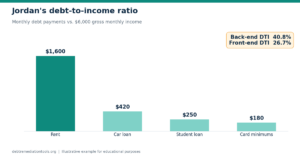
Jordan earns $72,000 per year, or $6,000 per month gross.
Monthly debt payments:
| Payment | Amount |
|---|---|
| Rent | $1,600 |
| Car loan | $420 |
| Student loan | $250 |
| Credit card minimums | $180 |
| Total | $2,450 |
Back-end DTI = $2,450 ÷ $6,000 = 40.8%
Front-end DTI (housing only) = $1,600 ÷ $6,000 = 26.7%
Front-end vs. back-end DTI
- Front-end DTI (housing ratio) looks only at housing costs. Mortgage lenders often look for 28% or less, although many programs allow more.
- Back-end DTI includes all monthly debt payments. It’s the broader and more commonly used measure.
The classic mortgage rule of thumb is 28/36: no more than 28% of gross income on housing and 36% on total debt. Actual lender limits are often higher, depending on the loan program, credit score, down payment and cash reserves.
What’s a good debt-to-income ratio?
These ranges are general guidelines, not lender rules:
| DTI | What it generally signals |
|---|---|
| Under 20% | Very manageable debt; strong position for new credit |
| 20% to 35% | Healthy; most lenders view favorably |
| 36% to 42% | Manageable but getting tight; may limit options |
| 43% to 49% | High; approval possible for some loans, often with stricter terms |
| 50% or more | Very high; difficult to qualify, and little room for unexpected expenses |
Mortgage guidelines
- For many years, 43% was a key threshold for “qualified mortgages.” Federal rules now use a pricing-based test instead of a strict DTI cap, but many lenders still use limits around 43% to 45% for conventional loans.
- Conventional loans backed by Fannie Mae and Freddie Mac can allow DTIs up to 50% in some cases with strong compensating factors, such as high credit scores or significant reserves.
- FHA loans often allow higher ratios with compensating factors.
- Lender overlays vary, so always ask.
In Jordan’s example, a 40.8% DTI may still qualify for some loans, but adding a mortgage payment higher than the current rent would push the ratio up quickly.
Why DTI matters even if you’re not applying for a loan
DTI is also a quick health check:
- A DTI above 40% often means there’s little room in your budget for savings or emergencies
- If a large share of your income goes to minimum payments, you may be paying a lot of interest while making slow progress on balances
- Watching DTI over time shows whether your debt situation is improving
How to lower your debt-to-income ratio
1. Pay down debts with the highest monthly payments relative to their balances
Paying off a small loan entirely eliminates its monthly payment, which can lower DTI faster than spreading extra money across several debts. In Jordan’s case, paying off the $420 car loan would bring DTI down to 33.8%.
2. Pay down credit card balances
Because minimum payments are usually based on the balance, lowering balances lowers minimums.
3. Choose a payoff strategy
The debt snowball (smallest balance first) eliminates payments quickly, which can help DTI. The debt avalanche (highest interest first) saves the most money. Compare both in our guide to the debt snowball vs. debt avalanche.
4. Consider consolidation carefully
A consolidation loan with a lower rate or longer term may reduce your monthly payments, lowering DTI. But a longer term can increase total interest. Run the numbers with our debt consolidation loan calculator guide or our free debt consolidation calculator.
5. Increase income
A raise, a second job, freelance work or rental income all lower DTI. If you’re applying for a mortgage, lenders will want to see documented, stable income.
6. Avoid new debt before applying
New car loans, financed furniture or new credit cards can raise DTI just when you need it lowest.
7. Correct errors
If your credit report shows debts that aren’t yours or payments that are wrong, lenders may count them. Dispute errors before applying. If you’re dealing with collection accounts, Debt Remediation offers guides on validating and disputing debts.
DTI vs. credit utilization
These are often confused:
| Debt-to-income ratio | Credit utilization | |
|---|---|---|
| Measures | Monthly debt payments vs. monthly income | Revolving balances vs. credit limits |
| Used by | Lenders in underwriting | Credit scoring models |
| Affects credit score? | No (income isn’t on credit reports) | Yes |
Learn more in our guide to credit utilization.
Frequently asked questions
No. Credit reports don’t include income, so DTI isn’t part of your score. But lenders use it alongside your score.
Lenders use gross income. For your own budgeting, it can also be helpful to calculate DTI using take-home pay, which gives a more conservative picture.
Generally no. Lenders count debt obligations, not regular living expenses.
For most loans other than mortgages, lenders count rent as part of your housing expense. For a mortgage application, the new mortgage payment replaces rent.
Paying off a loan with a high monthly payment, paying down credit cards to reduce minimums, or increasing income.
Calculate your DTI now
Gather your most recent pay stubs and a list of every monthly debt payment, then use our free debt-to-income calculator to find your ratio and see how paying off a specific debt would change it. Pair it with our budget planner to build a plan.
This article is for general educational purposes and is not financial, credit or lending advice. Lender requirements vary and change; consult your lender or a qualified financial professional.