

Key takeaways
- Debt settlement means negotiating with creditors to accept less than the full balance as payment in full.
- Advertised savings often leave out key costs: settlement company fees (commonly 15% to 25% of enrolled debt), taxes on forgiven debt, and balance growth from interest and late fees while you save.
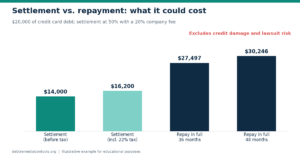
- In our example, settling $20,000 at 50% with a 20% fee cost $14,000 before taxes, and about $16,200 if the forgiven amount was fully taxable at 22%.
- Settlement usually requires falling behind on payments, which damages credit and can lead to collection lawsuits.
- Under federal rules, debt settlement companies that sell by phone generally can’t charge fees until they settle at least one of your debts and you make a payment under that settlement.
“Pay a fraction of what you owe!” Debt settlement ads can be compelling, especially if you’re overwhelmed by credit card balances. And settlement is a legitimate option for some people.
But the real savings are usually smaller than the headline, and the trade-offs are significant. This guide walks through the actual math, step by step, so you can decide with clear eyes.
How debt settlement works
Through a settlement company
- You enroll unsecured debts, usually credit cards, personal loans and medical bills.
- You stop paying the creditors directly and instead deposit money monthly into a dedicated account that you own and control.
- As balances become delinquent, the company negotiates lump-sum settlements once enough money has accumulated.
- When a settlement is reached and paid, the company charges its fee.
- Programs commonly last two to four years.
On your own
You can also negotiate directly with creditors or collectors, especially on accounts already charged off or in collections, without paying a company fee.
The variables that drive the math
- Enrolled debt: the total balance you enroll.
- Settlement percentage: what creditors accept, as a percentage of the balance at the time of settlement. This varies widely by creditor, account age and your circumstances.
- Balance growth: interest, late fees and penalty rates can increase balances before settlement.
- Company fee: commonly 15% to 25% of the enrolled debt (or a percentage of the amount saved).
- Taxes: forgiven debt may be taxable income.
- Time: months needed to save enough for settlements.
The example
Chris enrolls $20,000 of credit card debt.
Assumptions:
- Average settlement: 50% of the enrolled amount
- Company fee: 20% of enrolled debt
- Program length: 36 months
- Federal tax bracket: 22% (if the forgiven debt is taxable)
| Item | Amount |
|---|---|
| Enrolled debt | $20,000 |
| Settlement payments (50%) | $10,000 |
| Company fee (20% of enrolled) | $4,000 |
| Total paid through program | $14,000 |
| Monthly deposit (36 months) | about $389 |
| Debt forgiven | $10,000 |
| Possible federal tax on forgiven debt (22%) | $2,200 |
| Total cost if forgiven debt is fully taxable | $16,200 |
| Savings vs. original balance (before interest) | $3,800 to $6,000, depending on taxes |
Sensitivity: what if settlements come in higher or lower?
| Average settlement | Settlement payments | Fee (20%) | Total paid | Forgiven | Tax at 22% (if taxable) | Total cost incl. tax |
|---|---|---|---|---|---|---|
| 40% | $8,000 | $4,000 | $12,000 | $12,000 | $2,640 | $14,640 |
| 50% | $10,000 | $4,000 | $14,000 | $10,000 | $2,200 | $16,200 |
| 60% | $12,000 | $4,000 | $16,000 | $8,000 | $1,760 | $17,760 |
And if balances grow before settlement because of interest and late fees, settlements based on the higher balance cost more, and the forgiven amount reported on a 1099-C may be larger.
Taxes on forgiven debt
Creditors generally must file Form 1099-C when they cancel $600 or more. Forgiven debt is usually taxable unless an exclusion applies, most commonly the insolvency exclusion, which applies when your total liabilities exceed your total assets immediately before the cancellation.
Use our net worth statement template to estimate whether you might be insolvent, and read our sister site’s guide to Form 1099-C and canceled debt. Consult a tax professional before relying on any exclusion.
Comparing settlement with repayment
What would it cost to repay the same $20,000 at 22% APR?
| Repayment period | Monthly payment | Total interest | Total paid |
|---|---|---|---|
| 36 months | about $764 | about $7,497 | about $27,497 |
| 48 months | about $630 | about $10,246 | about $30,246 |
On paper, settlement (about $14,000 to $16,200) costs much less than repaying in full (about $27,500 over three years). But that comparison leaves out:
- Credit damage. Settlement requires delinquency, which typically causes serious, lasting damage to credit scores. Settled accounts are reported as “settled for less than the full balance” and late payments remain for up to seven years.
- Lawsuit risk. Creditors may sue while you’re saving. A judgment can lead to wage garnishment or bank levies.
- Uncertainty. Not every creditor will settle, and some debts may not settle at all.
- Collection activity. Calls and letters typically increase.
- Program dropout. Many people don’t complete settlement programs. If you leave early, you may have paid fees on some settled debts while others remain unpaid and larger.
Other alternatives to compare
- Debt management plan (DMP) through a nonprofit credit counseling agency: creditors may reduce interest rates and waive fees, and you repay the full balance over about three to five years, usually with less credit damage than settlement.
- Consolidation loan or balance transfer: if your credit qualifies, a lower rate can cut interest without delinquency. Compare with our consolidation loan calculator guide or run your own numbers with our free debt consolidation calculator.
- Snowball or avalanche payoff: if your budget allows. See our side-by-side example.
- Bankruptcy: for some people with overwhelming debt, Chapter 7 or Chapter 13 may provide more complete relief. Consult a bankruptcy attorney.
Your protections under federal law
The FTC’s Telemarketing Sales Rule protects consumers who are sold debt relief services over the phone. Among other things, debt relief companies:
- generally may not charge fees before they settle or change the terms of at least one debt and you’ve made at least one payment under that agreement
- must charge fees proportionally or as a percentage of savings if debts are settled one at a time
- must disclose key information, including how long the program will take, how much money you’ll need to save before each settlement offer, and possible negative consequences
- must let you withdraw from the program at any time and get back the money in your dedicated account, minus earned fees, without penalty
Red flags: upfront fees, guarantees that debts will be eliminated or reduced by a specific amount, claims of a “new government program,” and advice to stop communicating with creditors without explaining the consequences.
Before you choose settlement, validate your debts
If any accounts are already in collections, confirm the debt is accurate, that the collector owns it, and whether it’s past your state’s statute of limitations. You may not need to settle a debt you don’t owe. Our sister site, Debt Remediation, explains what debt remediation is and how to request debt validation.
Frequently asked questions
After fees, typical savings are smaller than advertised. In our example, settling $20,000 saved $3,800 to $6,000 off the balance, depending on taxes, before considering interest you avoided and costs like credit damage.
Yes. Accounts are typically reported as settled for less than the full balance, and late payments leading up to settlement remain for up to seven years.
Yes. Many consumers negotiate directly, particularly on charged-off or collection accounts. Always get the agreement in writing before paying.
Not always. Exclusions such as insolvency or bankruptcy may apply. Consult a tax professional.
Run your own numbers
Enter your enrolled debt, expected settlement percentage, fee, program length and tax bracket into our free debt settlement calculator to estimate your total cost, monthly deposits and true savings, and compare them with repayment options.
This article is for general educational purposes and is not financial, legal or tax advice. Debt settlement results vary and are not guaranteed. Consult qualified professionals before enrolling in any debt relief program.


1 Comment
Personal Net Worth Statement Template: How to Calculate It
[…] site’s guide to Form 1099-C and canceled debt, and see how taxes affect settlement math in our debt settlement calculator guide. Consult a tax professional for your […]