


Key takeaways
- A net worth statement (also called a personal balance sheet or personal financial statement) lists everything you own and everything you owe.
- Net worth = Total assets − Total liabilities. It can be negative, especially while paying down debt, and that’s okay; the trend matters most.
- Value assets at fair market value, what they’d realistically sell for today, not what you paid.
- Lenders often require a personal financial statement for business loans, mortgages and some personal loans.
- If you’ve had debt forgiven, a net worth calculation is the starting point for the insolvency exclusion on IRS Form 982.
Income tells you how much money flows in. A budget tells you where it goes. But neither tells you where you stand.
A net worth statement is a snapshot of your entire financial position on a single date. Updated a few times a year, it becomes one of the most motivating tools in a debt payoff journey, because even when your bank balance doesn’t change much, you can watch your net worth climb as debts shrink.
This guide walks through how to build one.
The formula
Net worth = Total assets − Total liabilities
- Assets: things you own that have monetary value.
- Liabilities: what you owe to others.
Step 1: List your assets
Cash and liquid assets
- checking accounts;
- savings and money market accounts;
- certificates of deposit; and
- cash on hand.
Investments
- brokerage accounts (stocks, bonds, funds);
- cryptocurrency (at current market value);
- cash value of permanent life insurance; and
- ownership interests in a business (at a reasonable estimate of value).
Retirement accounts
- 401(k), 403(b), 457 plans;
- IRAs and Roth IRAs; and
- vested pension benefits (if a value is available).
Some people list retirement accounts at their current balance; others reduce them to reflect estimated taxes and penalties on withdrawal. Choose one approach and stay consistent. For IRS insolvency calculations, use the fair market value as instructed in IRS guidance.
Real estate
- primary residence;
- rental properties; and
- land.
Use a realistic market value, such as a recent appraisal or comparable sales. Don’t use your purchase price or an optimistic online estimate.
Vehicles
Use a private-party value from a reputable pricing guide, adjusted for condition and mileage.
Personal property
- furniture and household goods;
- jewelry, collectibles and equipment; and
- other items with resale value.
Be conservative. Most household items are worth far less than their purchase price.
Money owed to you
- loans you’ve made to others that you expect to be repaid; and
- tax refunds due.
Step 2: List your liabilities
Use your debt inventory worksheet as the starting point.
- mortgage and home equity loans;
- auto loans;
- student loans;
- credit card balances;
- personal and consolidation loans;
- medical debt;
- buy-now-pay-later balances;
- taxes owed;
- money owed to family or friends;
- collection accounts and judgments; and
- co-signed loans (if you’re making the payments or likely to be responsible).
Step 3: Do the math
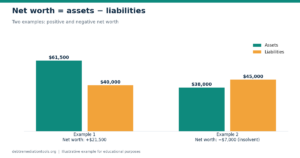
Example 1: Positive net worth
| Assets | Value |
|---|---|
| Checking and savings | $4,500 |
| 401(k) | $38,000 |
| Car | $14,000 |
| Household goods | $5,000 |
| Total assets | $61,500 |
| Liabilities | Balance |
|---|---|
| Car loan | $11,200 |
| Credit cards | $6,800 |
| Student loans | $22,000 |
| Total liabilities | $40,000 |
Net worth = $61,500 − $40,000 = $21,500
Example 2: Negative net worth (insolvent)
| Assets | Value |
|---|---|
| Checking and savings | $1,500 |
| 401(k) | $22,000 |
| Car | $11,000 |
| Household goods and personal property | $3,500 |
| Total assets | $38,000 |
| Liabilities | Balance |
|---|---|
| Credit card A | $9,000 |
| Credit card B | $7,000 |
| Car loan | $14,000 |
| Medical bills | $3,000 |
| Personal loan | $12,000 |
| Total liabilities | $45,000 |
Net worth = $38,000 − $45,000 = −$7,000
A negative net worth is common for people early in their careers, those with large student loans, or anyone recovering from a financial setback. The goal is to see it improve over time.
Useful ratios from your statement
| Ratio | Formula | What it tells you |
|---|---|---|
| Debt-to-asset ratio | Total liabilities ÷ Total assets | Above 1.0 means you owe more than you own |
| Liquid net worth | Liquid assets − Short-term debts | How much you could access quickly |
| Emergency coverage | Liquid savings ÷ Monthly essential expenses | Months of expenses covered (see our emergency fund guide) |
In Example 1, the debt-to-asset ratio is 0.65. In Example 2, it’s about 1.18.
Use #1: Tracking your progress
Update your statement every three to six months, on the same dates each year. Paying down debt increases net worth even when your savings stay flat. Seeing a number move from −$7,000 to −$2,000 to +$3,000 can be enormously motivating.
Use #2: Applying for loans
Lenders often ask for a personal financial statement, especially for:
- small business loans, including SBA loans, which typically require a personal financial statement from owners (if you’re sizing up a business loan, our business loan DSCR calculator can help you check your debt service coverage ratio)
- mortgages (assets and liabilities are part of the application)
- commercial real estate financing
- some personal loans and lines of credit
Be accurate. Overstating assets or omitting liabilities on a loan application can have serious legal consequences.
Use #3: Testing insolvency for canceled debt
If a lender forgives or settles a debt for less than you owe, the forgiven amount may be taxable income, and you may receive Form 1099-C. But if you were insolvent (liabilities greater than assets) immediately before the debt was canceled, you may be able to exclude some or all of the forgiven amount, up to the amount of your insolvency.
In Example 2, the person is insolvent by $7,000. If $10,000 of debt were forgiven, up to $7,000 could potentially be excluded, and $3,000 would be taxable.
Key points:
- The calculation is made immediately before the cancellation, using fair market values
- Retirement accounts count as assets for this purpose, even though they may be protected from creditors
- The exclusion is claimed on IRS Form 982, and IRS Publication 4681 includes an insolvency worksheet
Learn more in our sister site’s guide to Form 1099-C and canceled debt, and see how taxes affect settlement math in our debt settlement calculator guide. Consult a tax professional for your situation.
Common mistakes
- Overvaluing assets, especially cars, homes and personal property.
- Forgetting debts, such as medical bills, taxes or money owed to family.
- Mixing dates. All values should be as of the same date.
- Counting the same thing twice, like a home’s value and its equity.
- Not updating regularly.
Frequently asked questions
It depends on age, income and goals. The trend over time matters more than comparing yourself to averages.
Yes, at a realistic market value, with the mortgage listed as a liability. Some people also track net worth excluding the home to see their liquid position.
It’s a signal, not a judgment. Many people have negative net worth at some point. Focus on improving it.
Every three to six months is a good rhythm for most people.
Build yours now
Download our free net worth statement template, fill in your assets and liabilities, and set a reminder to update it next quarter.
This article is for general educational purposes and is not tax, legal or financial advice. Consult a qualified professional for tax matters, including insolvency calculations.


1 Comment
How to Budget to Pay Off Debt (Zero-Based & 50/30/20)
[…] update your debt list and net worth statement to see […]