

By the Debt Remediation Tools Team, Foxboro Consulting Group | Last updated: November 2026 | 5-minute read
Quick answer: To verify a debt collector’s license, find the company’s exact legal name and address from its letters, then search your state regulator’s database or the NMLS Consumer Access website, which many states use for collection agency and debt buyer licenses. Confirm the license type, status, and expiration. If the collector is unlicensed where required, you can raise it in your dispute and file a complaint with the state regulator.
Many states require debt collectors, and sometimes debt buyers, to be licensed. Licensing gives regulators oversight and gives consumers recourse. An unlicensed collector may be breaking state law, and in some situations, its collection efforts may be challenged.
This guide shows you how to check a debt collector’s license in minutes and what to do with what you find.
Key Takeaways
- Many states license collection agencies; some also license debt buyers.
- Massachusetts requires debt collectors and debt buyers collecting from residents to be licensed by the Division of Banks.
- NMLS Consumer Access lists licenses for many state regulators.
- Search using the company’s exact legal name; collectors often use trade names.
- Unlicensed collection activity can be reported to regulators and may be relevant in disputes and lawsuits.
Step 1: Identify the Company
From the collector’s letter, write down:
- Full company name, including any “doing business as” names
- Mailing address
- Phone number
- Any license number listed (some states require it on letters)
Step 2: Search the Right Database
| Resource | What it covers |
|---|---|
| NMLS Consumer Access (nmlsconsumeraccess.org) | Licenses issued through the Nationwide Multistate Licensing System for participating states and license types |
| Your state banking or financial regulator | State-specific license lookups, including collection agencies |
| Secretary of State business search | Whether the company is registered to do business |
| State attorney general | Complaint history and enforcement actions |
In Massachusetts, the Division of Banks licenses debt collectors and debt buyers and uses NMLS for many license types.
Step 3: Read the Results
Check:
- License type: Is it a collection agency or debt buyer license?
- Status: Active, inactive, surrendered, or revoked?
- Expiration date
- Name match: Does the licensed name match the company contacting you?
- Address: Does it match the letter?
Step 4: Record Your Findings
Take a screenshot showing the date of your search. Save it in your debt file.
What to Do If the Collector Is Not Licensed
- Include it in your written dispute and ask the collector to provide its license number.
- File a complaint with your state regulator.
- Consult a consumer attorney; unlicensed collection may support claims under state law, and in some cases under the FDCPA or state consumer protection laws such as Massachusetts Chapter 93A. See the Chapter 93A demand letter template.
- Be cautious with payments, especially if the company is pressuring you to pay quickly; see debt relief scams.
License Request Letter
[YOUR NAME]
[ADDRESS]
[DATE]
[COLLECTOR NAME AND ADDRESS]
Re: Account/reference number [NUMBER]
To Whom It May Concern:
Please provide your license number and the state agency that issued your license to collect debts from residents of [STATE]. Until I receive this information and verification of the debt, I dispute this account.
Sincerely,
[SIGNATURE]
[PRINTED NAME]
Lenders Too
Consumer lenders, including payday and installment lenders, often must be licensed. Checking a lender’s license can reveal loans that may violate state law.
Example: The Name That Didn’t Match
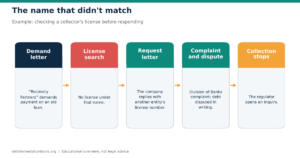
A hypothetical Massachusetts resident receives a letter from “Recovery Partners” demanding payment on an old loan. Her NMLS search finds no license under that name. She sends the license request letter. The company replies with a license number belonging to a different entity. She files a complaint with the Division of Banks and disputes the debt in writing. The company stops collection, and the regulator opens an inquiry.
Key Terms Defined
- Collection agency license: State authorization to collect debts from residents.
- Debt buyer license: State authorization, in some states, to purchase and collect consumer debts.
- NMLS: The Nationwide Multistate Licensing System used by many state regulators.
- DBA (doing business as): A trade name different from the legal name.
- License status: Whether a license is active, inactive, or revoked.
- State regulator: The agency that issues and oversees licenses, such as a Division of Banks.
Quick-Use Checklist
- ☐ Legal name, DBA, address, and phone recorded
- ☐ NMLS and state regulator databases searched
- ☐ License type, status, and expiration checked
- ☐ Screenshot saved with date
- ☐ License request letter sent if unclear
- ☐ Complaint filed if unlicensed
Common Mistakes to Avoid
- Searching only the trade name. Collectors often use a different legal name. Search every name on the letter.
- Assuming out-of-state means unlicensed. Many collectors are licensed in several states. Check your own state’s records.
- Paying before checking. If you are not sure the collector is legitimate, verify the license and the debt before you pay anything.
- Not saving proof. Take a dated screenshot of your search results.
Red Flags Beyond Licensing
- Pressure to pay immediately by gift card, wire, or cryptocurrency
- Refusal to send anything in writing
- Threats of arrest
- A caller who won’t give a mailing address
- A balance that doesn’t match your records
If you see these signs, read debt relief scams and report the company to your state attorney general.
Frequently Asked Questions
No. Requirements vary by state, and some exempt certain collectors, such as attorneys.
It depends on the state. Some exempt attorneys; others do not.
Not necessarily. The underlying debt may still exist, but the collector’s activities may be unlawful. Get legal advice.
Licensing generally depends on where the consumer resides. Check your state’s rules.
Check when you first hear from a collector and again if the company name changes.
Sources and Further Reading
- NMLS Consumer Access (nmlsconsumeraccess.org)
- Massachusetts General Laws Chapter 93, §§ 24–28 (debt collector licensing)
- Massachusetts Division of Banks, licensee search
- Consumer Financial Protection Bureau, state regulator contacts
Know Who You Are Dealing With
Debt Remediation Tools from Foxboro Consulting Group, Inc. includes this license lookup guide, the license request letter, and complaint templates.
Not sure if a collector is legitimate? Check its license before you say anything else.
Disclaimer: Templates and tools in this article are provided for general educational purposes and are not legal advice. Adapt every letter to your own facts, keep copies of everything you send, and consult a licensed attorney in your state before responding to a lawsuit or court deadline.