


By the Debt Remediation Tools Team, Foxboro Consulting Group | Last updated: November 2026 | 5-minute read
Quick answer: A Chapter 93A demand letter is a written notice Massachusetts consumers generally must send at least 30 days before suing a business for unfair or deceptive acts. It must identify the claimant, reasonably describe the unfair or deceptive practice, and describe the injury suffered. The business can make a written settlement offer within 30 days; an unreasonable response can increase damages later.
Massachusetts consumers have one of the strongest consumer protection laws in the country: General Laws Chapter 93A. Violations of the Attorney General’s debt collection regulations can support Chapter 93A claims. But before filing a 93A lawsuit against most businesses, a consumer generally must send a written demand letter at least 30 days in advance.
This guide explains what a 93A demand letter must include, provides a template for debt collection disputes, and outlines what happens next.
Key Takeaways
- Chapter 93A prohibits unfair or deceptive acts or practices in trade or commerce.
- Consumers generally must send a written demand letter at least 30 days before filing suit.
- The letter must identify the claimant, reasonably describe the unfair or deceptive practice, and describe the injury.
- The business may respond with a written tender of settlement within 30 days.
- A bad-faith or unreasonable response can expose the business to multiple damages and attorney’s fees.
When Chapter 93A Can Apply to Debt Collection
- Violations of the Attorney General’s debt collection regulations (940 CMR 7.00), such as excessive calls or contacting third parties improperly
- Collecting amounts not owed or not authorized
- Misrepresenting the status of a debt or threatening action that cannot be taken
- Unlicensed debt collection activity
- Unfair practices by creditors, including some original creditors
See Massachusetts debt collection laws.
Required Elements
- Your name and address (the claimant)
- A reasonable description of the unfair or deceptive act or practice
- A description of the injury suffered, which may include money lost, emotional distress, or time and expense
- Sent at least 30 days before filing suit
Many letters also state the relief requested, though the business decides how to respond.
The Template
[YOUR NAME]
[ADDRESS]
[DATE]
VIA CERTIFIED MAIL, RETURN RECEIPT REQUESTED
[BUSINESS NAME]
[ADDRESS / REGISTERED AGENT ADDRESS]
Re: Demand for Relief Pursuant to Massachusetts General Laws Chapter 93A, Section 9
Account/reference number: [NUMBER]
Dear Sir or Madam:
This letter is a demand for relief under Massachusetts General Laws Chapter 93A, Section 9.
Claimant: [YOUR NAME], residing at [ADDRESS].
Unfair or deceptive acts or practices:
1. [DESCRIBE SPECIFICALLY, e.g., Between (DATE) and (DATE), you initiated (NUMBER) telephone calls to my cellular telephone regarding this account within a seven-day period, in violation of 940 CMR 7.04(1)(f). A call log is enclosed.]
2. [e.g., On (DATE), your representative told my employer that I owed a debt, in violation of the Attorney General’s debt collection regulations, 940 CMR 7.00.]
3. [e.g., Your letter dated (DATE) demanded $(AMOUNT) in fees not authorized by my agreement or by law.]
Injury suffered:
[DESCRIBE, e.g., I experienced emotional distress, lost time from work, and incurred costs for (DESCRIBE). I paid $(AMOUNT) in unauthorized fees.]
Relief requested:
[e.g., Payment of $(AMOUNT); cessation of collection activity on this account; correction of credit reporting; written confirmation of these actions.]
Under Chapter 93A, you have 30 days from receipt of this letter to make a written tender of settlement. If you do not make a reasonable tender, I intend to pursue all remedies available under Chapter 93A, which may include multiple damages and attorney’s fees.
Enclosures: [LIST]
Sincerely,
[SIGNATURE]
[PRINTED NAME]
Tips for a Strong Demand
- Be specific: dates, quotes, amounts, and the rule violated.
- Attach evidence: call logs, letters, envelopes, payment records.
- Describe the injury honestly and with detail.
- Keep the tone factual.
- Send to the correct address, often the business’s main office or registered agent.
- Keep proof of delivery.
What Happens Next
| Business response within 30 days | What it means |
|---|---|
| Reasonable written settlement offer | You may accept or reject; if you reject and later win less, the offer may limit recovery |
| Unreasonable or no response | If you prove a willful or knowing violation or bad-faith refusal, damages may be doubled or tripled |
| Denial | You can decide whether to file suit |
Because 93A has important strategic consequences, consult a consumer attorney before sending a demand or responding to a settlement offer.
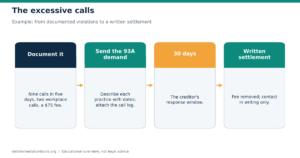
Example: The Excessive Calls
A hypothetical Springfield resident logs nine calls in five days from a creditor’s collection department, two calls to her workplace after she objected, and a letter demanding a $75 “processing fee.” She sends a 93A demand describing each practice with dates, attaching her call log and the letter. Within 30 days, the creditor offers a written settlement payment, removes the fee, and agrees to communicate only in writing. She accepts after reviewing it with an attorney.
Key Terms Defined
- Chapter 93A: Massachusetts’ consumer protection law prohibiting unfair or deceptive acts in trade or commerce.
- Demand letter: The written notice required before most consumer 93A lawsuits.
- Tender of settlement: The business’s written settlement offer in response.
- Multiple damages: Doubling or tripling of damages for willful or knowing violations or bad-faith refusals.
- 940 CMR 7.00: The Attorney General’s debt collection regulations.
- Registered agent: The person designated to receive legal documents for a business.
Quick-Use Checklist
- ☐ Claimant name and address
- ☐ Each unfair practice described with dates and facts
- ☐ Rule or regulation cited where known
- ☐ Injury described
- ☐ Relief requested
- ☐ Evidence enclosed
- ☐ Sent certified mail at least 30 days before any suit
- ☐ Response deadline calendared
Common Mistakes to Avoid
- Missing the 30-day wait. In most cases you must send the demand at least 30 days before filing a Chapter 93A lawsuit.
- Exaggerating the facts. Stick to what you can prove with documents. Overstatement weakens your credibility.
- Leaving out the relief requested. Say exactly what you want, such as a refund, a correction, or a payment amount.
- Ignoring the response. A reasonable written offer of settlement can limit damages later, so take any offer seriously and consult an attorney.
- Sending it to the wrong party. Address the business entity responsible, at its registered or principal address.
Where This Tool Fits in Your Workflow
| Step | Tool |
|---|---|
| Document the unfair act or practice | Evidence file and contact log |
| Confirm the collector’s license | Verify debt collector license |
| Send the 30-day demand | This template |
| Escalate if there is no reasonable offer | Massachusetts Attorney General complaint or consumer attorney |
Frequently Asked Questions
For most consumer claims under Section 9, yes, at least 30 days before suit. Exceptions exist, such as when the business has no place of business or assets in Massachusetts, or when the claim is asserted as a counterclaim.
Yes, if the collector’s conduct in trade or commerce was unfair or deceptive. FDCPA claims may also apply.
Not to send the letter, but the strategic stakes are significant. Many consumer attorneys handle 93A cases.
Claims may be raised as counterclaims, and the demand letter requirement may not apply to counterclaims. Ask an attorney.
Actual damages or a statutory minimum, potentially multiplied for willful or knowing violations, plus attorney’s fees if you prevail.
Sources and Further Reading
- Massachusetts General Laws Chapter 93A, §§ 2 and 9
- 940 CMR 7.00 (debt collection regulations)
- Massachusetts Attorney General, “Consumer Protection Law: Chapter 93A”
- Massachusetts Trial Court Law Libraries, “Massachusetts law about consumer protection”
Put Your Rights in Writing
Debt Remediation Tools from Foxboro Consulting Group, Inc. includes this 93A demand template, a call log, and evidence checklists for Massachusetts consumers.
A Massachusetts creditor or collector crossed the line? Document the facts and prepare your demand letter.
Disclaimer: Templates and tools in this article are provided for general educational purposes and are not legal advice. Adapt every letter to your own facts, keep copies of everything you send, and consult a licensed attorney in your state before responding to a lawsuit or court deadline.