

By the Debt Remediation Tools Team, Foxboro Consulting Group | Last updated: November 2026 | 5-minute read
Quick answer: If a collection account or other negative item is older than the Fair Credit Reporting Act’s reporting period, generally about seven years from the original date of first delinquency, send each bureau reporting it a written dispute stating that the item is obsolete, identify the correct delinquency date, attach supporting statements, and request deletion. Also dispute re-aged accounts showing a newer delinquency date.
Negative information does not stay on your credit report forever. Most collection accounts, charge-offs, and late payments must be removed after about seven years. But sometimes old accounts linger, or a debt buyer reports a newer delinquency date that keeps the account on your report longer than the law allows.
This letter to remove old debt from your credit report helps you dispute obsolete and re-aged items.
Key Takeaways
- The FCRA generally limits reporting of collections, charge-offs, and late payments to about seven years.
- For collections and charge-offs, the period is tied to the original date of first delinquency (DOFD), not the date a collector bought the debt.
- Paying or selling the debt does not restart the reporting period.
- Re-aging, reporting a newer DOFD, is an error you can dispute.
- Bankruptcies and some other items have different periods.
Step 1: Find the Date of First Delinquency
- Look at each credit report; many show the DOFD or an estimated removal date
- Review old statements for the first missed payment that was never brought current
- Request the date from the collector in a validation letter
Step 2: Determine Whether the Item Is Obsolete
| Item | General reporting limit |
|---|---|
| Collection accounts and charge-offs | About 7 years from original DOFD |
| Late payments | 7 years |
| Chapter 7 bankruptcy | Up to 10 years |
| Paid medical collections | Removed under bureau policy |
| Hard inquiries | 2 years |
Read how long collections stay on your credit report for details.
The Template
[YOUR NAME]
[ADDRESS]
Date of birth: [DOB]
Last four digits of SSN: [XXXX]
[DATE]
VIA CERTIFIED MAIL, RETURN RECEIPT REQUESTED
[CREDIT BUREAU NAME AND DISPUTE ADDRESS]
Re: Dispute of obsolete / re-aged account
To Whom It May Concern:
I dispute the following item in my credit file:
Furnisher: [NAME]
Account number (as shown): [PARTIAL NUMBER]
Original creditor (if shown): [NAME]
Date of first delinquency as reported: [DATE, if shown]
Actual date of first delinquency: [DATE]
[Choose one or both:]
[ ] This item is older than the reporting period permitted by the Fair Credit Reporting Act, 15 U.S.C. § 1681c, and must be removed.
[ ] This item reports an incorrect date of first delinquency. My last payment on the original account was made on [DATE], and the account was never brought current. Enclosed are [statements/bank records] showing this. The correct date must be reported, and the item removed when the reporting period ends.
Please investigate and delete this item [or correct the date]. Please send me the results and an updated copy of my credit report.
Enclosures: [ID, proof of address, supporting documents]
Sincerely,
[SIGNATURE]
[PRINTED NAME]
Tips
- Avoid acknowledging the debt or promising payment in your letter.
- Attach proof of the original delinquency where possible.
- Dispute with every bureau reporting the item.
- Also dispute with the furnisher if the date is re-aged, since the furnisher controls the data.
- Save the results in case the item reappears.
If the Item Reappears
Obsolete items should not be re-reported. If a new collector reports the same old debt, dispute again with your prior results attached and consider a CFPB complaint. Re-aging may also violate the FCRA and, for collectors, the FDCPA.
Related Disputes
- Debts discharged in bankruptcy that still show balances: use the discharged debt letter.
- Paid or small medical collections: use the medical collection removal letter.
Example: The Debt Buyer’s New Date
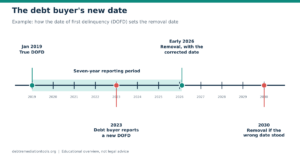
A hypothetical consumer’s credit card went delinquent in January 2019. A debt buyer bought the account in 2023 and reported a DOFD of 2023, which would keep the collection until 2030. She sends this letter with statements showing her last payment in late 2018. The bureaus correct the DOFD to January 2019, and the collection is removed when the period expires in early 2026.
Key Terms Defined
- Obsolete information: Information older than the FCRA permits to be reported.
- Date of first delinquency (DOFD): The date an account first became delinquent and was never brought current.
- Re-aging: Reporting a later delinquency date than the true date.
- Reporting period: The maximum time negative information can appear.
- Furnisher: The company providing the information to the credit bureau.
- Reinvestigation: The bureau’s investigation of a consumer dispute.
Quick-Use Checklist
- ☐ DOFD identified from records
- ☐ Item confirmed as obsolete or re-aged
- ☐ Evidence attached
- ☐ Letters sent to each bureau and the furnisher
- ☐ Certified mail used
- ☐ Results saved for future disputes
Common Mistakes to Avoid
- Using the date the collector bought the debt. The seven-year period runs from the original delinquency, not from a sale or a collection date.
- Paying an old debt to “clean up” the report. Payment does not shorten the reporting period, and in some states it can restart the lawsuit clock.
- Confusing reporting limits with lawsuit limits. A debt can fall off your report and still be legally collectable, or the reverse.
- Sending no evidence. Old statements, a prior credit report, or a charge-off notice showing the original delinquency date help prove re-aging.
Find the Original Delinquency Date
- Look for the “date of first delinquency” on each bureau’s report.
- Compare it with your own records of the last payment.
- Check whether the date changed when the account was sold.
- If the dates conflict, include both in your dispute and attach your evidence.
Frequently Asked Questions
No. The reporting period is tied to the original delinquency.
No. The statute of limitations governs lawsuits and is set by state law.
Request the method of verification, dispute with the furnisher, and file a complaint if necessary.
Collection may continue, subject to the law, but collectors cannot sue or threaten to sue on time-barred debt.
Positive closed accounts often remain longer, which can help your history.
Sources and Further Reading
- Fair Credit Reporting Act, 15 U.S.C. § 1681c(a) and (c)
- Fair Credit Reporting Act, 15 U.S.C. § 1681s-2 (furnisher responsibilities)
- Consumer Financial Protection Bureau, credit reporting complaint portal
- AnnualCreditReport.com
Clear Out What the Law Says Must Go
Debt Remediation Tools from Foxboro Consulting Group, Inc. includes this obsolete-item dispute letter, a DOFD worksheet, and follow-up templates.
Old debts still on your report? Find the original delinquency date and send this letter.
Disclaimer: Templates and tools in this article are provided for general educational purposes and are not legal advice. Adapt every letter to your own facts, keep copies of everything you send, and consult a licensed attorney in your state before responding to a lawsuit or court deadline.