

By the Debt Remediation Tools Team, Foxboro Consulting Group | Last updated: November 2026 | 5-minute read
Quick answer: After a bankruptcy discharge, debts that were discharged should be reported with a zero balance and a status such as “discharged in bankruptcy,” not as past due or in collection. If a discharged debt still shows a balance, send each bureau and the furnisher a dispute with your discharge order and the schedule listing the debt. If a collector tries to collect a discharged debt, send the discharge order and consult your bankruptcy attorney.
A bankruptcy discharge is supposed to be a fresh start. But many people find their credit reports still showing discharged debts as unpaid, past due, or in collection. These errors can lower scores and confuse lenders, making it harder to rebuild.
This guide provides a template to fix discharged debt still on your credit report and explains what to do if a collector pursues a discharged debt.
Key Takeaways
- Discharged debts should show a zero balance and a status such as “discharged in bankruptcy” or “included in bankruptcy.”
- The bankruptcy itself may remain on reports for up to 10 years (Chapter 7) or commonly 7 years (Chapter 13).
- Dispute inaccurate post-discharge reporting with each bureau and the furnisher.
- Attach the discharge order and the schedule listing the debt.
- Collecting a discharged debt can violate the discharge injunction.
What Correct Reporting Looks Like
| Field | Should show |
|---|---|
| Balance | $0 |
| Status | Discharged / included in bankruptcy |
| Past-due amount | $0 |
| Payment history after filing | No new late payments after the bankruptcy filing |
| Collection accounts | Zero balance, noted as discharged |
Accurate history before the bankruptcy, such as late payments that occurred before filing, may remain for the reporting period.
The Template
[YOUR NAME]
[ADDRESS]
Date of birth: [DOB]
Last four digits of SSN: [XXXX]
[DATE]
VIA CERTIFIED MAIL, RETURN RECEIPT REQUESTED
[CREDIT BUREAU NAME AND DISPUTE ADDRESS]
Re: Dispute of debts discharged in bankruptcy
To Whom It May Concern:
I filed for bankruptcy under Chapter [7/13] in the U.S. Bankruptcy Court for the District of [STATE], Case No. [NUMBER], on [FILING DATE]. I received a discharge on [DISCHARGE DATE]. A copy of the discharge order and the schedule listing the debts below is enclosed.
The following accounts were discharged but are reported inaccurately:
1. [Creditor/collector], account [partial number] – reported as [past due / balance $____ / in collection]. Should be reported with a $0 balance and as discharged in bankruptcy.
2. [Creditor/collector], account [partial number] – [describe].
Please investigate and correct these accounts to reflect a $0 balance and discharged status, and remove any late payments reported after my filing date.
Please send me the results and an updated copy of my credit report.
Enclosures: Discharge order; Schedule E/F [or relevant schedule]; ID; proof of address
Sincerely,
[SIGNATURE]
[PRINTED NAME]
Also Notify the Furnisher
Send a similar letter to the creditor or collector reporting the account, asking it to update its reporting. Furnishers control the data the bureaus receive.
If a Collector Tries to Collect
The discharge order permanently prohibits creditors from collecting discharged debts as personal liabilities. If a collector contacts you:
- Send a copy of the discharge order and schedule by certified mail.
- Keep records of every contact.
- Contact your bankruptcy attorney; the bankruptcy court can sanction violations of the discharge injunction.
- Consider FDCPA claims for collectors that misrepresent the status of the debt.
Debts That Were Not Discharged
Some debts are not discharged, such as most student loans, certain taxes, and support obligations. Review your discharge and schedules carefully before disputing. Debts reaffirmed during the case are also not discharged.
Rebuilding After Bankruptcy
Correct reporting is the foundation for rebuilding credit. Next steps include secured cards, credit builder loans, and on-time payments. See how to rebuild credit after debt.
Example: Six Accounts, One Packet
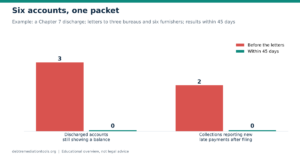
A hypothetical consumer received a Chapter 7 discharge eight months ago. Her credit reports show six discharged accounts, three with balances and two collections reporting new late payments after her filing date. She sends this letter to all three bureaus and the six furnishers with her discharge order and schedules. Within 45 days, all accounts show zero balances and discharged status, and her score improves significantly.
Key Terms Defined
- Discharge: A court order releasing the debtor from personal liability for certain debts.
- Discharge injunction: The legal prohibition on collecting discharged debts.
- Schedules: Bankruptcy forms listing assets, debts, income, and expenses.
- Reaffirmation agreement: An agreement to remain liable on a debt despite bankruptcy.
- Included in bankruptcy: A credit reporting status indicating the account was part of a bankruptcy.
- Furnisher: A company that reports account information to credit bureaus.
Quick-Use Checklist
- ☐ Discharge order and schedules obtained (from your attorney or PACER)
- ☐ Each inaccurate account listed
- ☐ Letters sent to all bureaus reporting errors
- ☐ Letters sent to furnishers
- ☐ Certified mail used
- ☐ Results reviewed and saved
Common Mistakes to Avoid
- Assuming the bankruptcy fixed everything. Creditors and collectors sometimes keep reporting balances after a discharge. Check every account.
- Leaving out the case number and discharge date. Bureaus need these to match the account to your case.
- Disputing accounts that weren’t discharged. Reaffirmed debts, most student loans, and certain taxes may not be discharged. Confirm with your bankruptcy attorney.
- Paying a collector on a discharged debt. If a creditor tries to collect a discharged debt, stop and talk to your attorney.
Your Post-Discharge Credit Review
- Pull all three credit reports 60 to 90 days after discharge.
- Make a list of every account included in the bankruptcy.
- Confirm each shows a $0 balance and “discharged in bankruptcy.”
- Send this letter for each error.
- Recheck after 30 to 45 days and save each results letter.
Frequently Asked Questions
Chapter 7 can remain up to 10 years from filing; Chapter 13 is commonly reported for 7 years.
Often, because balances and new late payments are removed.
From your bankruptcy attorney, the court, or the federal court records system (PACER).
Selling discharged debt for collection raises serious legal issues. Collectors attempting to collect it may face sanctions and FDCPA claims.
Reaffirmed debts remain your responsibility and should be reported based on your payments.
Sources and Further Reading
- 11 U.S.C. § 524 (effect of discharge and discharge injunction)
- Fair Credit Reporting Act, 15 U.S.C. § 1681c (reporting of bankruptcies) and § 1681i (disputes)
- Consumer Financial Protection Bureau, bankruptcy and credit reporting guidance
- PACER (Public Access to Court Electronic Records)
Make Your Fresh Start Real
Debt Remediation Tools from Foxboro Consulting Group, Inc. includes this post-bankruptcy dispute letter, a discharge tracking sheet, and rebuilding checklists.
Discharged debts still showing balances? Gather your discharge order and send this letter.
Disclaimer: Templates and tools in this article are provided for general educational purposes and are not legal advice. Adapt every letter to your own facts, keep copies of everything you send, and consult a licensed attorney in your state before responding to a lawsuit or court deadline.