


By the Debt Remediation Tools Team, Foxboro Consulting Group | Last updated: November 2026 | 5-minute read
Quick answer: A payment plan letter proposes a specific monthly amount you can afford to repay a verified debt. It should request written confirmation of the total amount, number of payments, no added interest or fees, what happens if a payment is late, how the account will be reported, and that the collector will not sue while you comply. Pay by a method you control rather than giving ongoing account access.
Not everyone can make a lump-sum settlement. A structured payment plan can resolve a valid debt over time while protecting your budget. But informal phone arrangements often go wrong: payments are applied unexpectedly, interest keeps accruing, or one late payment voids the deal.
This payment plan letter to a collector template puts your proposal in writing and asks for the terms that protect you.
Key Takeaways
- Propose a plan only for debts you have verified, and check the statute of limitations first.
- Choose a payment you can sustain for the entire term.
- Require written confirmation of the total, the schedule, and the absence of added interest or fees.
- Ask what happens if a payment is late and request a grace period.
- Avoid giving collectors ongoing access to your bank account.
Before You Propose a Plan
- Verify the debt. Use validation rights first.
- Check the statute of limitations. In many states, a payment may restart the clock on an old debt.
- Build a budget to find a sustainable amount. See how to build a debt payoff plan. Then test your amount with our free debt payoff calculator.
- Compare with settlement. Sometimes a smaller lump sum later is better than many payments; see the negotiation script.
The Template
[YOUR NAME]
[ADDRESS]
[DATE]
VIA CERTIFIED MAIL, RETURN RECEIPT REQUESTED
[COLLECTOR NAME AND ADDRESS]
Re: Account/reference number [NUMBER]
Original creditor: [NAME]
To Whom It May Concern:
I am writing to propose a payment arrangement for the above account. Without waiving any rights or defenses, I propose the following:
1. Total amount to resolve the account: $[TOTAL]
2. Monthly payment: $[AMOUNT], beginning [DATE], due on the [DAY] of each month, for [NUMBER] months.
3. No additional interest, fees, or charges will be added during the plan.
4. A grace period of [10] days for each payment.
5. Upon completion, the account will be considered paid in full [or settled in full], and no remaining balance will be sold, assigned, or collected.
6. You will report the account as [paying as agreed / paid in full upon completion] to any consumer reporting agency to which you report.
7. You will not file a lawsuit regarding this account while I comply with the plan.
I will make each payment by [check / money order / one-time electronic payment that I initiate]. I do not authorize recurring automatic withdrawals.
If you accept, please send a signed written agreement reflecting these terms before my first payment date.
Sincerely,
[SIGNATURE]
[PRINTED NAME]
Terms Worth Negotiating
| Term | Why it matters |
|---|---|
| Fixed total amount | Prevents the balance from growing |
| No added interest or fees | Keeps payments going to the balance |
| Grace period | Protects against minor delays |
| Missed payment cure | Allows you to catch up before the agreement is voided |
| No lawsuit while compliant | Removes the threat of suit during the plan |
| Reporting terms | Clarifies credit report status |
| No resale | Prevents a new collector from appearing |
Paying Safely
Pay by a method you control, such as a check or a one-time electronic payment. If you previously authorized automatic withdrawals and want to stop them, see how to revoke ACH authorization. Keep a record of every payment and confirmation.
If You Fall Behind
Contact the collector before the payment is late, explain the issue briefly, and request a modification in writing. Keep making smaller payments if possible to demonstrate good faith.
Example: A Plan That Stayed on Track
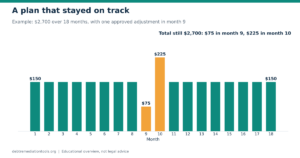
A hypothetical consumer owes $2,700 on a verified medical collection. He proposes $150 per month for 18 months, no added interest, a 10-day grace period, and no lawsuit while he complies. The collector accepts and sends a signed agreement. He pays by check each month and keeps copies. When his car breaks down in month 9, he calls before the due date and gets written approval to pay $75 that month and $225 the next. He completes the plan, and the collector sends a paid-in-full letter.
Key Terms Defined
- Payment plan: An agreement to repay a debt in installments.
- Grace period: Extra days after a due date before a payment is considered late.
- Default (under the plan): Failure to meet plan terms, which may void the agreement.
- Paid in full: Status indicating the full agreed amount has been paid.
- Recurring authorization: Permission for automatic periodic withdrawals.
- Revival: Restarting the statute of limitations on an old debt through payment or acknowledgment in some states.
Quick-Use Checklist
- ☐ Debt verified and statute of limitations checked
- ☐ Affordable monthly amount chosen from your budget
- ☐ Total, schedule, and no-interest terms included
- ☐ Grace period and cure terms requested
- ☐ No-lawsuit and no-resale terms requested
- ☐ Signed agreement received before first payment
- ☐ Payment method you control
Common Mistakes to Avoid
- Offering more than you can keep paying. A plan you break can lead to collection restarting, sometimes with a lawsuit. Base the amount on your actual budget.
- Skipping the written agreement. Get the payment amount, number of payments, due dates, and what happens after the final payment in writing before you pay.
- Letting the collector pull payments automatically. Keep control of the timing by paying yourself each month.
- Forgetting the statute of limitations. In some states a payment on an old debt can restart the clock. Check the dates before you offer anything on an old account.
Track Every Payment
| Payment # | Due date | Amount | Date paid | Confirmation # |
|---|---|---|---|---|
| 1 | ||||
| 2 | ||||
| 3 |
Keep this table with your agreement. If the collector later disputes a payment, your records and bank statements are your proof.
Frequently Asked Questions
Only if the agreement says so. Request a no-lawsuit term while you comply.
Yes, but the agreement should be filed with the court or include dismissal terms.
It may help show payments being made, and a paid status may be viewed better than unpaid, depending on the scoring model.
You can decline and offer another payment method. Automatic payments are convenient but reduce your control.
Yes. Many collectors accept reduced totals paid over time.
Sources and Further Reading
- Consumer Financial Protection Bureau, sample letters for debt collection
- Electronic Fund Transfer Act and Regulation E, 12 C.F.R. § 1005.10
- 15 U.S.C. § 1692f (FDCPA unfair practices, including post-dated checks)
- Federal Trade Commission, “Debt Collection FAQs”
Pay on Your Terms
Debt Remediation Tools from Foxboro Consulting Group, Inc. includes payment plan letters, payment logs, and modification request templates to keep your plan on track.
Ready to propose a plan? Set your number from your budget, then send this letter.
Disclaimer: Templates and tools in this article are provided for general educational purposes and are not legal advice. Adapt every letter to your own facts, keep copies of everything you send, and consult a licensed attorney in your state before responding to a lawsuit or court deadline.