
By the Debt Remediation Tools Team, Foxboro Consulting Group | Last updated: November 2026 | 5-minute read
Quick answer: A good debt settlement call follows a script: confirm the account and that the debt is verified, state a brief hardship, make a specific lump-sum offer below your maximum, respond to counteroffers in small steps, ask how the account will be reported, and require written confirmation before paying. Never give ongoing bank access or agree to more than your budget allows.
Negotiating a debt can feel intimidating, especially when the person on the other end negotiates every day. A script levels the field. It keeps you focused, prevents accidental admissions or overcommitments, and helps you ask for the terms that protect you.
This debt settlement negotiation script walks you through a typical call from opening to written confirmation, with responses to common objections.
Key Takeaways
- Verify the debt and check the statute of limitations before negotiating.
- Know your maximum lump sum before you call and start lower.
- Keep explanations short; let numbers do the talking.
- Ask how the account will be reported and whether the balance will be sold.
- Get the agreement in writing before paying, and pay with a method you control.
Before the Call: Preparation Sheet
| Item | Your answer |
|---|---|
| Account and collector name | ______ |
| Debt verified? | Yes / No |
| Statute of limitations checked? | Yes / No |
| Current balance claimed | $______ |
| My maximum lump sum | $______ |
| My opening offer | $______ |
| My walk-away point | $______ |
| Hardship in one sentence | ______ |
Use your personal financial statement to set realistic numbers.
The Script
1. OPENING
“Hello, my name is [NAME]. I’m calling about account [NUMBER]. Before we talk, may I have your name and a direct callback number? Is this call recorded?”
2. CONFIRM THE ACCOUNT (WITHOUT ADMITTING LIABILITY)
“I’d like to discuss resolving this account. Can you confirm the current balance and who owns the account?”
3. BRIEF HARDSHIP
“My finances have changed because of [ONE-SENTENCE REASON]. I’m not able to pay the full balance.”
4. OPENING OFFER
“I’ve been able to set aside a lump sum of $[OPENING OFFER]. I can pay that to settle the account in full.”
5. IF THEY COUNTER
“I understand. That’s more than I have available. I could stretch to $[SMALL INCREASE], but that’s close to my limit.”
6. IF THEY ASK FOR BANK INFORMATION
“I don’t provide account access by phone. Once I receive the agreement in writing, I’ll send a one-time payment.”
7. TERMS TO CONFIRM
“If we agree, will the agreement state that this payment settles the account in full, that the balance won’t be sold or collected later, and how it will be reported to the credit bureaus?”
8. CLOSING
“Please send the written agreement to [ADDRESS / EMAIL]. When I receive it, I’ll pay by [DATE] using [METHOD].”
Handling Common Objections
| What they say | How to respond |
|---|---|
| “This offer expires today.” | “I understand. I need the terms in writing before I pay. If the offer is gone, I’ll consider other options.” |
| “We need a payment now to set this up.” | “I’ll pay as soon as I receive the written agreement.” |
| “We can only do 80%.” | “That isn’t possible for me. Is there a supervisor who can review a lower amount?” |
| “Can you do a payment plan instead?” | “I could consider a plan of $[AMOUNT] per month if the total is reduced and the terms are in writing.” |
| “We don’t send agreements in writing.” | “Then I’m not able to proceed. A legitimate settlement can be confirmed in writing.” |
What Not to Say
- “I know I owe this.”
- “I’ll pay whatever you want.”
- “Here’s my bank login” or card number for automatic payments
- Detailed information about your assets or other accounts
- Promises you cannot keep
After the Call
- Log the call: date, time, name, offers, and responses.
- Wait for the written agreement and review every term.
- Pay by cashier’s check, money order, or a one-time payment you initiate.
- Save proof of payment and the agreement permanently.
- Check your credit reports 30 to 60 days later.
If a lump sum is not possible, use the payment plan letter to propose structured payments.
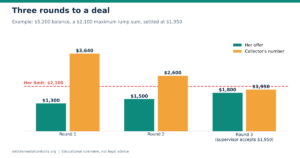
Example: Three Rounds to a Deal
A hypothetical consumer owes $5,200 to a debt buyer on a verified account. Her maximum lump sum is $2,100. She opens at $1,300. The collector counters at $3,640. She responds at $1,500, citing her limit. The collector drops to $2,600. She moves to $1,800 and asks for a supervisor. The supervisor accepts $1,950 if paid within 20 days. She requests written terms stating the account is settled in full and will not be resold, receives them two days later, and pays by cashier’s check.
Key Terms Defined
- Lump-sum settlement: A one-time payment accepted as full resolution of a debt.
- Counteroffer: A response proposing different terms.
- Walk-away point: The maximum you will pay before ending negotiations.
- Settled in full: Language confirming no remaining balance will be pursued.
- One-time payment: A payment you initiate once, without ongoing access.
- Re-sale: Selling the remaining balance to another collector, which your agreement should prohibit.
Common Mistakes to Avoid
- Naming your maximum first. Open lower and leave room to move.
- Agreeing without the account verified. If you have not confirmed the collector owns the debt and the balance is right, request validation first.
- Giving bank access on the call. Pay by a method you control, after you have the agreement in writing.
- Forgetting the tax question. Forgiven amounts over $600 may be reported to the IRS on Form 1099-C. Ask a tax professional whether the insolvency exclusion may apply to you.
- Accepting vague credit reporting terms. Ask how the account will be reported once it is paid, and get the answer in writing.
Practice Before You Call
- Read the script aloud twice.
- Write your opening offer, your target, and your walk-away number on a card.
- Have your personal financial statement open so your numbers are real.
- Decide in advance which date you can pay, and do not let the call change it.
- After the call, send a short email or letter confirming what was discussed and asking for the written agreement.
Frequently Asked Questions
There is no standard. Offers depend on the debt’s age, owner, documentation, and your finances. Start lower than your maximum.
Either, but confirm everything in writing before paying.
Recording laws vary. Massachusetts generally requires all parties’ consent. Take detailed notes instead if you cannot record.
Ask for a supervisor, try again later, or send a written offer. Consider whether other options, such as disputing the debt, are appropriate.
Forgiven amounts of $600 or more may be reported on Form 1099-C. An insolvency exclusion may apply.
Sources and Further Reading
- Consumer Financial Protection Bureau, sample letters and debt negotiation guidance
- 15 U.S.C. § 1692e (FDCPA prohibition on false or misleading representations)
- IRS Publication 4681 (canceled debt)
- Massachusetts General Laws Chapter 272, § 99 (recording conversations)
Negotiate With Confidence
Debt Remediation Tools from Foxboro Consulting Group, Inc. includes this script, settlement letter templates, and a negotiation log so every call moves you closer to a written agreement.
Ready to make an offer? Fill out the prep sheet and practice the script before you call.
Disclaimer: Templates and tools in this article are provided for general educational purposes and are not legal advice. Adapt every letter to your own facts, keep copies of everything you send, and consult a licensed attorney in your state before responding to a lawsuit or court deadline.