
Once you know how much you can put toward debt each month, the next question is where the extra money should go. The two most popular strategies are the debt snowball and the debt avalanche. Both work. They differ in what they optimize: motivation or math.
This guide explains both methods, runs the numbers on a realistic example, and helps you decide which fits you.
Key Takeaways
- Both methods pay minimums on every debt and direct extra money to one target debt at a time.
- The snowball targets the smallest balance first for quick wins.
- The avalanche targets the highest interest rate first to minimize total interest.
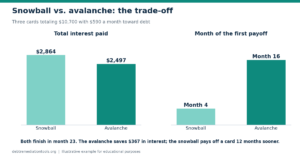
- In our example, the avalanche saved about $367 in interest, while the snowball delivered the first payoff 12 months sooner.
How the Debt Snowball Works
- List debts from smallest balance to largest.
- Pay the minimum on every debt.
- Put all extra money toward the smallest balance.
- When it is paid off, add its payment to the next smallest, and repeat.
Strength: Fast early wins build motivation and simplify your bills.
Weakness: You may pay more interest if high-rate debts have larger balances.
How the Debt Avalanche Works
- List debts from highest interest rate to lowest.
- Pay the minimum on every debt.
- Put all extra money toward the highest-rate debt.
- When it is paid off, roll its payment to the next highest rate, and repeat.
Strength: Minimizes total interest and often total time.
Weakness: The first payoff can take a long time if the highest-rate debt is large.
Worked Example
Assume three credit cards and a total monthly debt budget of $590:
| Debt | Balance | Interest rate (APR) | Minimum payment |
|---|---|---|---|
| Store card | $1,200 | 24% | $40 |
| Visa | $3,500 | 18% | $90 |
| Mastercard | $6,000 | 27% | $160 |
| Total | $10,700 | $290 |
That leaves $300 extra each month beyond the minimums. Assuming no new charges and fixed minimums, a month-by-month calculation produces:
| Result | Snowball | Avalanche |
|---|---|---|
| First debt paid off | Store card in month 4 | Mastercard in month 16 |
| Second debt paid off | Visa in month 13 | Store card in month 18 |
| All debts paid off | Month 23 | Month 23 |
| Total interest paid | About $2,864 | About $2,497 |
In this example, both methods finish in about the same time, but the avalanche saves about $367 in interest because the highest-rate card is attacked first. The snowball delivers the first payoff in four months instead of sixteen, which can make a big difference for motivation.
Results change with different balances, rates, and budgets, so run your own numbers.
Which Method Should You Choose?
| Choose the snowball if… | Choose the avalanche if… |
|---|---|
| You need early wins to stay motivated | You are motivated by saving money |
| You have several small balances | Your highest-rate debt is not much larger than the others |
| You want fewer bills quickly | Interest rates differ significantly |
| You have struggled to stick with plans before | You are comfortable with a longer wait for the first payoff |
Hybrid Approaches
- Quick win first: Pay off one very small debt using the snowball, then switch to the avalanche.
- Rate threshold: Use the avalanche for debts above a certain rate and the snowball for the rest.
- Promotional rates: If a card has a 0% promotional rate ending soon, prioritize it before the rate jumps.
Before You Start: Debt Remediation Comes First
Payoff methods assume every debt is valid and accurate. Before putting extra money toward collection accounts, verify them. Some may be duplicates, inflated, or time-barred, and a payment could restart the statute of limitations in some states. Use the debt tracker spreadsheet to flag accounts that need verification, and read how to build a debt payoff plan.
Tips for Success With Either Method
- Stop adding new debt to the cards you are paying off.
- Automate minimum payments to avoid late fees.
- Ask for lower interest rates; a lower rate helps either method.
- Use windfalls, such as tax refunds or bonuses, for extra payments.
- Track progress visually, such as a chart of balances.
- Revisit your budget monthly.
Where This Method Fits in Your Workflow
- Before: Verify collection accounts and remove errors so you only target real debts; use the verification response checklist.
- Alongside: Confirm your monthly amount with the budget template.
- After: Track each payoff in your debt tracker and watch your debt-to-income ratio fall.
Quick-Use Checklist
- ☐ Balances, rates, and minimums confirmed from statements
- ☐ Monthly debt budget set
- ☐ Method chosen (snowball, avalanche, or hybrid)
- ☐ Minimums automated
- ☐ Target debt identified
- ☐ Rollover plan ready for each payoff
Frequently Asked Questions
Often the avalanche, because less money goes to interest. In some cases, like our example, the finish line is about the same, but the avalanche costs less.
Many people use the snowball for debts with similar rates, since the interest difference is small.
Most people focus these methods on unsecured debts like credit cards and personal loans while keeping secured debts current.
A consolidation loan with a lower rate can help, but you still need a plan and must avoid running balances back up.
Run Your Own Numbers
Debt Remediation Tools from Foxboro Consulting Group, Inc. includes a payoff calculator that compares the snowball and avalanche using your actual balances, rates, and budget.
Not sure which debt to attack first? Enter your numbers and see both plans side by side.
Disclaimer: Templates and tools in this article are provided for general educational purposes and are not legal advice. Adapt every letter to your own facts, keep copies of everything you send, and consult a licensed attorney in your state before responding to a lawsuit or court deadline.