

Credit report errors are common, and they can cost you money through higher interest rates, denied applications, and larger deposits. The Fair Credit Reporting Act (FCRA) gives you the right to dispute inaccurate or incomplete information and requires the credit bureaus to investigate.
A clear, specific written dispute gets better results than a vague online click. Below is a free credit dispute letter template, plus guidance on using it effectively.
Key Takeaways
- Dispute each error separately and specifically, explaining exactly what is wrong and what correction you want.
- Attach copies of supporting documents and proof of identity.
- Bureaus generally must complete their investigation within 30 days, or 45 days in some cases.
- Dispute with each bureau reporting the error, and consider disputing with the furnisher too.
What Can You Dispute?
- Accounts that are not yours
- Incorrect balances, limits, or payment status
- Duplicate collection accounts
- Wrong date of first delinquency (which affects how long an item can be reported)
- Accounts discharged in bankruptcy still showing a balance
- Paid or settled accounts showing as unpaid
- Items older than the reporting period
- Personal information errors (names, addresses) that could signal a mixed file
The Template
[YOUR FULL NAME]
[ADDRESS]
[CITY, STATE ZIP]
Date of birth: [DOB]
Last four digits of SSN: [XXXX]
[DATE]
VIA CERTIFIED MAIL, RETURN RECEIPT REQUESTED
[CREDIT BUREAU NAME]
[DISPUTE MAILING ADDRESS]
Re: Dispute of inaccurate information in my credit file
To Whom It May Concern:
I am writing to dispute the following information in my credit file, which is inaccurate or incomplete. I request that you investigate under the Fair Credit Reporting Act, 15 U.S.C. § 1681i, and correct or delete each item.
Item 1:
Creditor/furnisher name: [NAME]
Account number (as shown): [PARTIAL NUMBER]
What is inaccurate: [EXAMPLE: This account shows a balance of $2,140. I paid this account in full on (DATE). See enclosed payment confirmation.]
Requested correction: [EXAMPLE: Report the balance as $0 and status as paid.]
Item 2:
Creditor/furnisher name: [NAME]
Account number (as shown): [PARTIAL NUMBER]
What is inaccurate: [EXAMPLE: This collection duplicates the account reported by (OTHER COLLECTOR) for the same original debt.]
Requested correction: [EXAMPLE: Delete the duplicate entry.]
Enclosed are copies of my identification, proof of address, and supporting documents.
Please send me the results of your investigation and an updated copy of my credit report.
Sincerely,
[SIGNATURE]
[PRINTED NAME]
Enclosures: [LIST]
Where to Send It
Each bureau publishes a dispute mailing address and online dispute options on its official website. Check the current address before mailing, because they can change. Send a separate letter to each bureau that reports the error.
Documents to Enclose
| Error type | Helpful documents |
|---|---|
| Paid or settled account | Payment confirmation, settlement letter |
| Bankruptcy discharge | Discharge order and schedule listing the debt |
| Not your account | Identity theft report, proof of address at the time |
| Duplicate account | Collector letter showing the debt was sold or assigned |
| Wrong delinquency date | Statements showing your last payment |
| Personal information error | ID, utility bill, lease |
Always send copies, never originals.
Timeline
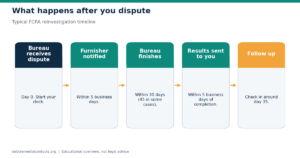
- Bureau receives your dispute.
- Within 5 business days, the bureau generally notifies the furnisher and forwards relevant information.
- Within 30 days (or 45 in certain cases), the bureau must complete its reinvestigation.
- Within 5 business days of completion, the bureau must notify you of the results.
- If information is changed or deleted, you can request that the bureau notify anyone who received your report recently.
If Your Dispute Is Rejected
- Request the method of verification using the method of verification letter
- Dispute directly with the furnisher
- Submit new evidence
- Add a consumer statement to your file
- File a complaint with the Consumer Financial Protection Bureau
- Consult a consumer attorney about possible FCRA claims
Avoid These Mistakes
- Disputing accurate information as inaccurate. Disputes should be truthful.
- Mass-disputing every negative item. Bureaus may treat repetitive, unsupported disputes as frivolous.
- Using a generic “609” template expecting automatic deletions. Section 609 provides access to your file, not automatic removal.
- Forgetting to check all three bureaus. Errors may appear on only one.
For the bigger picture, read how to dispute a debt on your credit report.
Example: Correcting a Re-Aged Collection
A hypothetical consumer sees a collection account on her Experian report with a date of first delinquency of 2021, even though she stopped paying the original credit card in 2018. If the 2021 date were correct, the account would stay on her report years longer.
She uses the template to dispute the date, attaching old statements showing her last payment in early 2018. Experian’s investigation returns with the date corrected, and the account is now scheduled to drop off years earlier. She checks Equifax and TransUnion, finds the same error on one of them, and disputes it there too.
Where This Letter Fits in Your Workflow
- Before: Pull reports with the free weekly credit report guide and compare all three bureaus side by side.
- Alongside: Record each dispute and its 30-day clock in your debt tracker.
- After: If an item comes back “verified” but is still wrong, send the method of verification letter.
- If the item is fraudulent: Use the identity theft dispute kit to request a block instead of a standard dispute.
Quick-Use Checklist
- ☐ One letter per bureau reporting the error
- ☐ Each item listed separately with a specific reason
- ☐ Requested correction stated
- ☐ Copies of ID, proof of address, and evidence enclosed
- ☐ Certified mail and tracking saved
- ☐ Follow-up date calendared for day 35
Frequently Asked Questions
Online is faster, but mail allows you to include detailed explanations and documents and creates a clear record. Many consumers use certified mail for important disputes.
No. Disputes do not lower your score.
Yes, but list each separately and specifically.
Bureaus need enough information to identify you. Many accept the last four digits with other identifiers; follow the bureau’s instructions.
Clean Up Your Report
Debt Remediation Tools from Foxboro Consulting Group, Inc. includes this dispute letter, a method of verification follow-up, and a dispute tracking log so you can manage every dispute from start to finish.
Found an error on your credit report? Use this template today and track the 30-day clock.
Disclaimer: Templates and tools in this article are provided for general educational purposes and are not legal advice. Adapt every letter to your own facts, keep copies of everything you send, and consult a licensed attorney in your state before responding to a lawsuit or court deadline.