
Key takeaways
- For most people, the answer is both, in stages: build a small starter emergency fund first, then attack high-interest debt, then build a full emergency fund.
- A starter fund of $500 to $1,000, or about one month of essential expenses, keeps small emergencies from becoming new credit card debt.
- Don’t skip an employer retirement match while paying off debt. It’s often the highest return available.
- A full emergency fund is commonly three to six months of essential expenses, more if your income is irregular or you’re the sole earner.
- Keep emergency savings safe and accessible, such as in a high-yield savings account, not invested in the stock market.
It’s one of the most common money dilemmas: you have credit card debt charging 20% or more, and you have little or no savings. Every dollar you save instead of paying debt seems to cost you interest. But every dollar you put toward debt instead of saving leaves you exposed if the car breaks down.
The math says pay off high-interest debt. Real life says something always goes wrong. The best approach balances both.
Why you need an emergency fund even while in debt
Imagine you’re paying aggressively on your credit cards, with no savings. Then your car needs a $900 repair. With no cash, you put it on a credit card, and you’re back where you started, often feeling defeated.
An emergency fund:
- prevents new debt when unexpected expenses hit
- protects your payoff plan from setbacks
- reduces stress, which helps you stick with the plan
- gives you options if you lose income
Yes, keeping $1,000 in savings while carrying a 24% credit card costs something. At a few percent interest in savings versus 24% on the card, the difference is roughly $200 a year. But putting a single $1,000 emergency on a card and carrying it could cost similar interest, plus the risk of late fees, damaged momentum and higher balances. For most people, a small buffer is worth it.
The step-by-step order
Step 1: Cover essentials and minimum payments
Before anything else, keep current on housing, utilities, food, transportation and minimum payments on all debts. Late payments add fees and hurt your credit.
Step 2: Build a starter emergency fund
Target $500 to $1,000, or roughly one month of essential expenses if your situation is less stable. Build it quickly, even if that means temporarily paying only minimums on debt.
Step 3: Capture any employer retirement match
If your employer matches retirement contributions, contribute enough to get the full match. A 50% or 100% match is an immediate return that usually beats paying extra on debt.
Step 4: Attack high-interest debt
Put every extra dollar toward high-interest debt, typically credit cards, payday loans and other consumer debts above about 8% to 10%. Use the debt snowball or avalanche to choose an order, and see your payoff date with our free debt payoff calculator.
Step 5: Build a full emergency fund
Once high-interest debt is gone, redirect those payments to savings until you have three to six months of essential expenses.
Step 6: Handle lower-interest debt and long-term goals
With a full emergency fund in place, decide how to balance lower-interest debt (such as some student loans or a mortgage) with retirement, education and other goals.
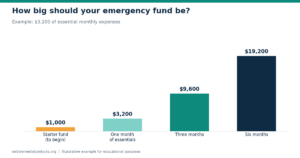
How much should your emergency fund be?
Calculate essential monthly expenses
Include only what you’d need to pay if your income stopped:
- rent or mortgage
- utilities
- groceries
- transportation
- insurance premiums
- minimum debt payments
- childcare
- essential medical costs
Exclude dining out, entertainment, extra debt payments and other discretionary spending.
Example
| Essential expense | Monthly |
|---|---|
| Rent | $1,550 |
| Utilities and phone | $275 |
| Groceries | $450 |
| Transportation | $350 |
| Insurance | $120 |
| Minimum debt payments | $455 |
| Total essentials | $3,200 |
| Goal | Amount |
|---|---|
| Starter fund (about one month) | $3,200 (or $1,000 to start) |
| Three months | $9,600 |
| Six months | $19,200 |
Note that once your debts are paid off, your essential expenses drop, and so does the emergency fund you need.
When to aim higher
Consider six months or more if:
- your income is irregular (self-employed, commission-based, seasonal)
- you’re the only earner in your household
- you have dependents
- you work in an industry with frequent layoffs
- you have health issues or high insurance deductibles
- you own a home or an older car
When three months may be enough
- stable job with in-demand skills;
- dual-income household;
- good disability and health insurance coverage; and
- other accessible resources.
Where to keep your emergency fund
Your emergency fund should be:
- safe: not exposed to stock market losses
- liquid: available within a day or two
- separate: not mixed with everyday spending
Good options:
- high-yield savings accounts at FDIC-insured banks or NCUA-insured credit unions
- money market accounts
- for a portion of a larger fund, short-term CDs or Treasury bills, as long as you can access some money immediately
Avoid keeping emergency funds in stocks, cryptocurrency or retirement accounts (which may have penalties and taxes on early withdrawal).
What counts as an emergency?
Yes:
- job loss or reduced income
- urgent medical or dental expenses
- essential car repairs
- urgent home repairs (furnace, roof leak)
- emergency travel for family
No:
- planned expenses (use sinking funds; see our budget guide)
- sales and discounts
- vacations
If you use the fund, pause extra debt payments and rebuild it before resuming.
Special situations
You have debts in collections
Collection accounts may need a different approach than current debts. Before paying, confirm the debt is accurate and yours, and understand whether it’s past your state’s statute of limitations. Keep your emergency fund separate from accounts that could be subject to a bank levy if you have an unpaid judgment. Our sister site, Debt Remediation, explains bank levies and protected funds.
You have very high-interest debt
If you have payday loans or debts above 30% APR, focus on eliminating them quickly after building a minimal starter fund.
Your job feels unstable
If layoffs seem likely, lean toward building a larger cash cushion first. Cash is more useful than a lower debt balance if your income stops.
Frequently asked questions
Generally not entirely. Keeping at least a starter fund protects you from new debt. If you have a large emergency fund and high-interest debt, using part of the excess may make sense.
Available credit can be a backup, but it’s not a substitute. Credit limits can be reduced, and using credit for emergencies adds high-interest debt.
Build the starter fund as quickly as possible, often within one to three months. The full fund can take a year or more after high-interest debt is paid off.
No. Keep sinking funds for predictable irregular expenses separate.
Calculate your target
List your essential monthly expenses and use our free emergency fund calculator to find your starter, three-month and six-month goals. Then add it to your net worth statement to track progress.
This article is for general educational purposes and is not financial advice.