


By the Debt Remediation Tools Team, Foxboro Consulting Group | Last updated: November 2026 | 5-minute read
Quick answer: A motion to vacate a default judgment asks the court to set aside a judgment entered because you did not respond or appear. It usually includes the motion, a sworn affidavit explaining why the default happened (such as improper service or excusable neglect), evidence, and a proposed answer showing a meritorious defense. File promptly, use your court’s forms where available, and attend the hearing.
Many consumers learn about a debt lawsuit only after a default judgment has been entered and their wages or bank account are targeted. Courts can set aside default judgments in appropriate circumstances, but the motion must be prepared carefully and filed promptly.
This guide provides a practical framework for a motion to vacate a default judgment in a debt case. Court rules and forms vary, so use this to organize your filing, check your court’s requirements, and seek help from legal aid or an attorney.
Key Takeaways
- Common grounds include improper service, excusable neglect, fraud or misrepresentation, and a void judgment.
- Courts usually want to see a sworn explanation, prompt action, and a meritorious defense.
- Time limits apply; some grounds must be raised within one year under rules modeled on federal Rule 60(b).
- Attach evidence and a proposed answer.
- Ask the court whether enforcement can be paused while the motion is pending.
Step 1: Get the Court File
Request copies of the complaint, return of service, default, judgment, and any post-judgment filings. Check where and how you were supposedly served.
Step 2: Identify Your Grounds
| Ground | Evidence that helps |
|---|---|
| Improper service | Lease, utility bills, or employer records showing you lived elsewhere; affidavits from household members |
| Excusable neglect | Hospital records, proof of travel, documentation of emergencies |
| Fraud or misrepresentation | Evidence the plaintiff misstated the amount, ownership, or your liability |
| Void judgment | Lack of jurisdiction or fundamental defects |
| Payment or settlement | Receipts, settlement agreements |
Step 3: Show a Meritorious Defense
Defenses might include the statute of limitations, lack of ownership or standing, payment, identity theft, or an incorrect amount. Attach a proposed answer listing these defenses.
Framework: Motion
[COURT NAME]
[DIVISION/COUNTY]
[PLAINTIFF], Plaintiff
v. Case No. [NUMBER]
[YOUR NAME], Defendant
DEFENDANT’S MOTION TO VACATE DEFAULT JUDGMENT
Defendant [NAME] moves under [Rule 60(b) of the applicable Rules of Civil Procedure / court rule] to vacate the default judgment entered on [DATE], and states:
1. Defendant did not receive notice of this action because [service was made at an address where Defendant did not live / other reason].
2. Defendant learned of the judgment on [DATE] when [describe, e.g., a bank account was frozen] and filed this motion promptly.
3. Defendant has meritorious defenses, including [statute of limitations / lack of standing / payment / identity], as set forth in the attached proposed Answer.
4. Plaintiff will not be unfairly prejudiced if the judgment is vacated and the case is decided on the merits.
WHEREFORE, Defendant requests that the Court vacate the default judgment, [stay enforcement / release any garnished funds], and allow Defendant to file the attached Answer.
Date: [DATE]
[SIGNATURE]
[NAME, ADDRESS, PHONE, EMAIL]
CERTIFICATE OF SERVICE
I certify that on [DATE] I served this motion on [PLAINTIFF’S ATTORNEY] by [METHOD].
Framework: Supporting Affidavit
AFFIDAVIT OF [YOUR NAME]
I, [NAME], state under the pains and penalties of perjury:
1. I am the Defendant in this case.
2. On [DATE], the date of the alleged service, I lived at [ADDRESS], not at [ADDRESS LISTED ON RETURN OF SERVICE]. Attached as Exhibit A is [lease/utility bill].
3. I did not receive the summons or complaint.
4. I first learned of this case on [DATE] when [EVENT].
5. [Describe defenses briefly, e.g., My last payment on the account was in (YEAR).]
Signed under the pains and penalties of perjury on [DATE].
[SIGNATURE]
Use the wording your jurisdiction requires for sworn statements; some courts require notarization.
Step 4: File and Serve
- File the motion, affidavit, exhibits, and proposed answer with the clerk.
- Ask about filing fees and fee waivers.
- Serve copies on the plaintiff’s attorney and file a certificate of service.
- Ask the clerk about scheduling a hearing and pausing enforcement.
Step 5: Prepare for the Hearing
Bring copies of everything, organized as exhibits. Use the court hearing checklist. If the judgment is not vacated, ask about exemptions and payment terms; a personal financial statement can help.
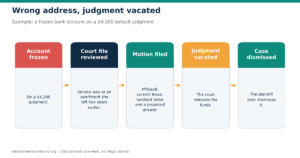
Example: Wrong Address, Judgment Vacated
A hypothetical consumer’s bank account is frozen on a $4,300 judgment. The court file shows service at an apartment she left two years earlier. She files a motion with an affidavit, her current lease, and a letter from her former landlord, plus a proposed answer raising the statute of limitations. The court vacates the judgment and releases the funds. The plaintiff later dismisses the case.
Key Terms Defined
- Default judgment: A judgment entered because the defendant did not respond or appear.
- Motion to vacate: A request asking the court to set aside a judgment.
- Return of service: The document stating how and where papers were served.
- Excusable neglect: A legitimate reason for failing to respond, such as illness.
- Meritorious defense: A defense that, if proven, could change the outcome.
- Stay of enforcement: A pause on collection while the motion is decided.
Quick-Use Checklist
- ☐ Court file obtained and service reviewed
- ☐ Grounds identified with evidence
- ☐ Sworn affidavit prepared
- ☐ Proposed answer with defenses attached
- ☐ Motion filed and served promptly
- ☐ Hearing date calendared and exhibits organized
Common Mistakes to Avoid
- Waiting to gather “perfect” evidence. Courts expect you to act promptly once you learn of a judgment. File with what you have and add more later if allowed.
- Leaving out a defense. Many courts want to see that a new trial could change the result. Attach a proposed answer.
- Not serving the other side. Send a copy of everything you file to the plaintiff’s attorney, and file a certificate of service.
- Missing the hearing. If you file the motion and then miss the hearing, the motion is likely to be denied.
Where This Tool Fits in Your Workflow
| Step | Tool |
|---|---|
| Get and review the court file | Clerk’s office |
| Prepare the motion and affidavit | This framework |
| Organize exhibits and hearing notes | Court hearing checklist |
| Protect exempt funds if the motion fails | Exemption forms from the court |
Frequently Asked Questions
It depends on the grounds and court rules. Some grounds have a one-year limit; others, such as void judgments, may not. Act quickly in all cases.
Not necessarily, but legal aid or an attorney can greatly improve your chances.
Courts may order funds returned depending on the outcome.
You may still claim exemptions, negotiate, or pursue other options. Ask about appeal rights.
Small claims courts have their own procedures and forms. Ask the clerk.
Sources and Further Reading
- Federal Rule of Civil Procedure 60(b) and Massachusetts Rule of Civil Procedure 60(b)
- Massachusetts Uniform Small Claims Rules
- Massachusetts Trial Court self-help resources
- National Consumer Law Center, consumer debt litigation resources
Act Fast, File Right
Debt Remediation Tools from Foxboro Consulting Group, Inc. includes this motion framework, affidavit templates, and exhibit checklists. Always check your court’s forms and seek legal help when possible.
Discovered a judgment you never knew about? Get the court file today and start your motion.
Disclaimer: Templates and tools in this article are provided for general educational purposes and are not legal advice. Adapt every letter to your own facts, keep copies of everything you send, and consult a licensed attorney in your state before responding to a lawsuit or court deadline.