If you have several debts, the order you pay them off matters. The two most popular methods, avalanche and snowball, both work. They just reward you in different ways. Here is how each one works and how to choose.
What both methods have in common
Both methods follow the same three rules:
- Pay the minimum on every debt, every month.
- Put every extra dollar toward one target debt.
- When the target is paid off, roll its whole payment into the next target.
That rollover is what makes either method much faster than paying minimums. Your total monthly payment stays the same, but more of it attacks principal every time a debt disappears.
The avalanche method
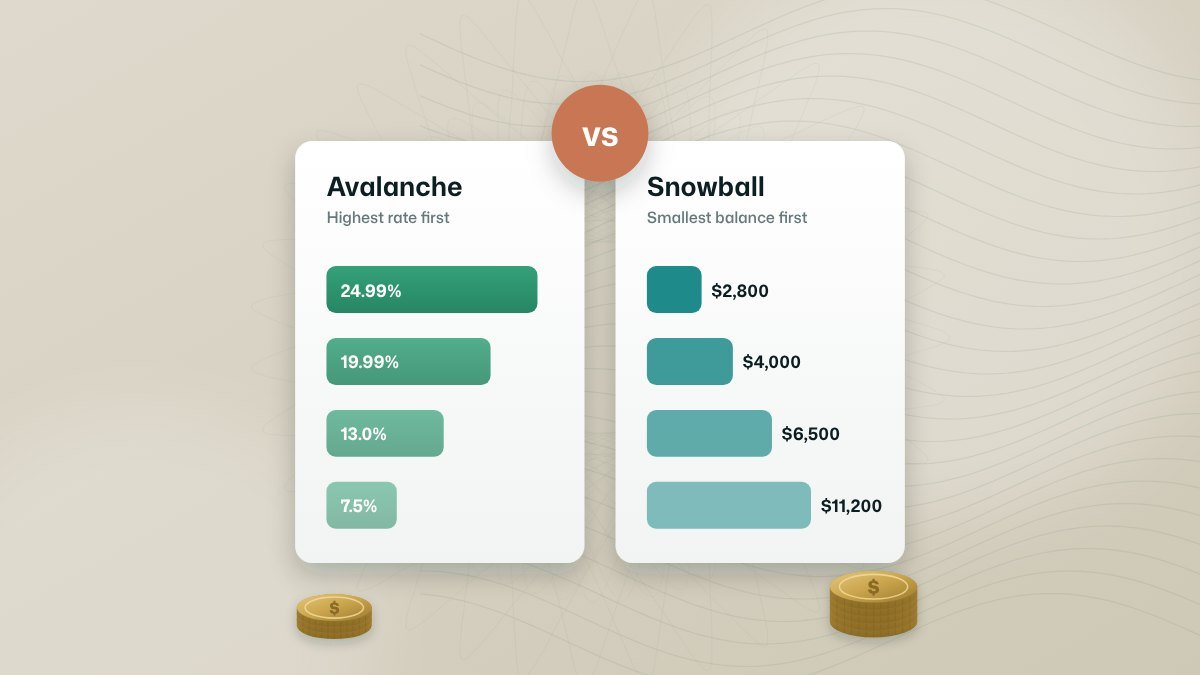
Target the debt with the highest interest rate first. Then move to the next-highest rate.
Because you are always paying down the most expensive debt, the avalanche method costs the least interest and usually gets you debt-free a little sooner. The downside: if your highest-rate debt is also a large balance, it can take months before you pay off your first debt.
The snowball method
Target the smallest balance first, whatever its interest rate. Then move to the next-smallest.
You pay off your first debt quickly, which feels good and frees up a payment. Many people find that early win keeps them going. The downside: you may pay more interest overall, because a high-rate debt can sit untouched while you clear small ones.
An example
Say you owe:
| Debt | Balance | APR | Minimum |
| Credit card A | $6,500 | 24.99% | $195 |
| Credit card B | $2,800 | 19.99% | $84 |
| Personal loan | $4,000 | 13% | $135 |
| Car loan | $11,200 | 7.5% | $320 |
With $200 a month on top of the minimums, our Debt Payoff Calculator shows:
- Avalanche:debt-free in 2 years and 8 months, about $4,590 in interest.
- Snowball:debt-free in 2 years and 8 months, about $5,050 in interest. The first debt (Credit card B) is gone in 11 months.
- Minimums only:debt-free in about 4 years and 10 months, about $8,360 in interest.
In this case, avalanche saves about $460. Either method beats paying only the minimums by more than $3,000 and two years.
How to choose
Choose avalanche if:
- your high-rate debts are a big share of what you owe;
- you are motivated by saving money; and
- you are confident you will stick with the plan without quick wins.
Choose snowball if:
- you have tried to pay off debt before and lost steam;
- you have several small balances you could clear quickly; or
- the calculator shows only a small difference in interest.
There is also a middle path: start with one or two very small balances for a quick win, then switch to avalanche.
Make either method work
- Stop adding new debt: To the accounts you are paying down.
- Automate your minimum payments: So you never pay a late fee.
- Throw windfalls at your target debt: Tax refunds, bonuses, side income.
- Check whether a lower rate is available: If most of your debt is at a high rate, a consolidation loan could help. Test it with the Debt Consolidation Calculator.
Run your own numbers
Every situation is different. Enter your own debts in the Debt Payoff Calculator to see your debt-free date under both methods.
If your minimum payments are already more than you can manage, a payoff method may not be enough. Compare your debt relief options or talk to Debt Remediation.