

When you apply for a business loan, the lender’s first question is simple: can this business afford the payments? The number they use to answer it is the debt service coverage ratio, or DSCR. Knowing yours before you apply tells you how much you can borrow and where you stand.
DSCR in one line
DSCR = cash flow available for debt service ÷ annual debt payments
A DSCR of 1.00x means the business earns exactly enough to make its loan payments, with nothing left over. A DSCR of 1.25x means it earns 25% more than it needs for its payments.
What lenders look for
- Below 1.00x: Cash flow does not cover the payments. Most lenders will decline.
- 00x to 1.19x: Covered, but thin. One slow month could mean a missed payment.
- 20x to 1.25x: A common minimum for bank and credit union loans.
- 35x and above: Comfortable. Lenders see lower risk and may offer better terms.
SBA loan programs generally allow lower minimums, around 1.10x to 1.15x depending on the program, but lenders can set higher standards of their own. Always ask your lender which minimum applies.
How lenders calculate cash flow
Most lenders start with EBITDA: earnings before interest, taxes, depreciation and amortization. In practice, they take your net profit from your tax return or financial statements and:
- Add back interest expense, depreciation and amortization, and documented one-time costs;
- Subtract owner draws or distributions that are not already paid as a salary, because the owner needs to be paid; and
- Sometimes adjust for unusual items, such as a one-time large contract.
Debt payments include the principal and interest on every business loan, equipment lease and line of credit, plus the loan you are applying for.
A quick example
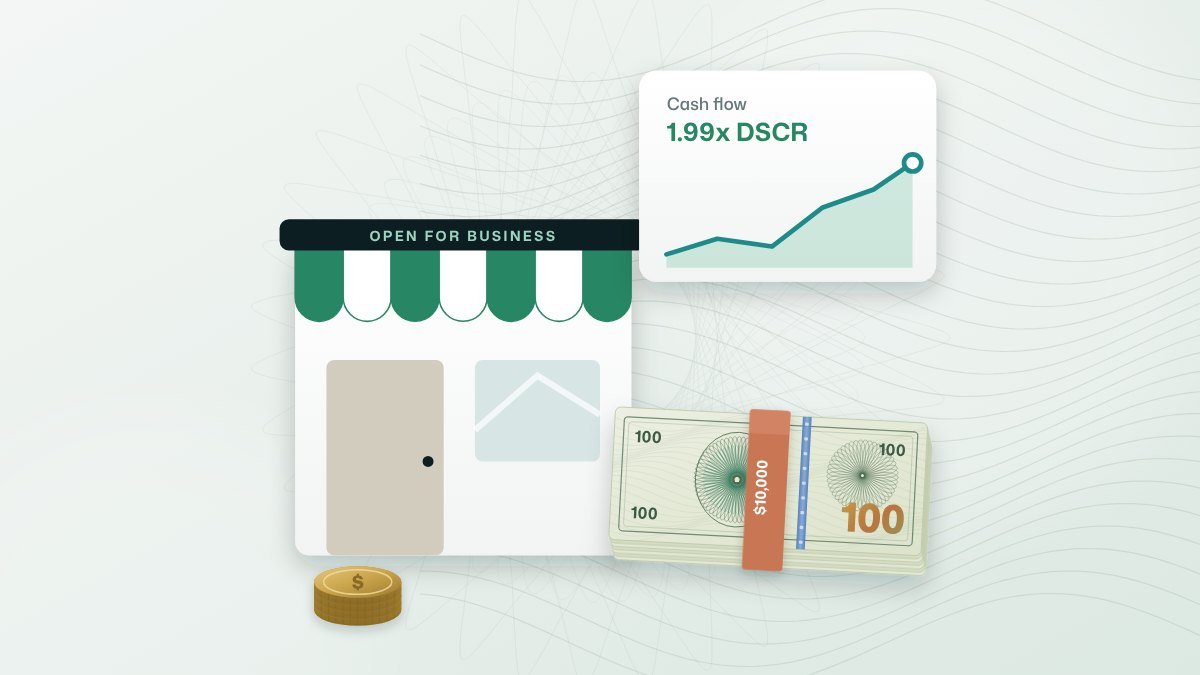
A business shows $150,000 of cash flow after add-backs and owner draws. It pays $34,800 a year on existing loans and wants a $250,000, 10-year loan at 10.5%, which costs about $40,480 a year.
DSCR = $150,000 ÷ ($34,800 + $40,480) = 1.99x. Comfortably above a 1.25x minimum. At 1.25x, the same cash flow could support a loan of about $526,000 on the same terms.
Five ways to improve your DSCR
- Lengthen the term. A longer loan lowers annual payments and raises DSCR, though total interest rises.
- Borrow less. A bigger down payment or seller financing on an acquisition can reduce the bank loan.
- Refinance expensive debt. Short-term, high-cost debt such as merchant cash advances can drag DSCR down. Replacing it with a term loan can lower total payments.
- Document every legitimate add-back. Lenders accept one-time and non-cash expenses only when you can prove them.
- Improve cash flow first. Faster collections and tighter cost control show up directly in the ratio. It can be worth waiting a few months to apply.
Global DSCR: the owner counts too
Many lenders, including SBA lenders, also run a global cash flow analysis. They combine the business’s cash flow with the owners’ personal income and personal debt payments to make sure the owners can live on what the business pays them and still cover every debt. Keep your personal finances in order before you apply.
Check your own DSCR
Use our free Business Loan / DSCR Calculator to find your DSCR with a new loan and the largest loan your cash flow supports. For more on keeping business debt healthy, read Managing Business Debt.
Planning a loan, purchase or restructuring?
Foxboro Consulting Group helps business owners with financial analysis, valuation and due diligence.