

By the Debt Remediation Tools Team, Foxboro Consulting Group | Last updated: November 2026 | 5-minute read
Quick answer: To dispute rental debt, send your former landlord a written letter challenging specific move-out charges with evidence such as move-in and move-out photos, the lease, and the security deposit records. If the debt has gone to collections, send a validation request to the collector within 30 days. In Massachusetts, landlords who fail to follow security deposit rules may lose the right to keep the deposit and may owe damages.
Move-out charges for cleaning, painting, carpet replacement, or unpaid rent can follow you long after you leave. Sometimes they are legitimate. Often they include normal wear and tear, charges never documented, or amounts that ignore your security deposit. Unresolved rental debt can land on your credit report and in tenant screening reports.
This guide provides two letters: one to your former landlord and one to a collection agency, with a focus on Massachusetts rules.
Key Takeaways
- Landlords generally cannot charge for normal wear and tear.
- Challenge each charge specifically and attach evidence.
- In Massachusetts, security deposit rules are strict, and violations can carry significant penalties.
- If a collector contacts you, request validation within 30 days.
- Dispute inaccurate rental debt on credit and tenant screening reports.
Normal Wear and Tear vs. Damage
| Typically normal wear and tear | Typically damage |
|---|---|
| Minor scuffs and nail holes | Large holes in walls |
| Faded paint | Unauthorized paint colors |
| Worn carpet in traffic areas | Burns, stains, or pet damage |
| Loose door handles | Broken doors or windows |
Letter 1: Dispute to Former Landlord
[YOUR NAME]
[CURRENT ADDRESS]
[DATE]
VIA CERTIFIED MAIL, RETURN RECEIPT REQUESTED
[LANDLORD OR PROPERTY MANAGER NAME AND ADDRESS]
Re: Dispute of charges for [RENTAL ADDRESS]
Lease dates: [START] to [END]
Security deposit: $[AMOUNT]
Dear [NAME]:
I dispute the charges in your letter dated [DATE], totaling $[AMOUNT].
Specifically:
1. [CHARGE, e.g., carpet replacement, $900]: This is normal wear and tear after a [NUMBER]-year tenancy. See enclosed move-out photos.
2. [CHARGE, e.g., cleaning, $300]: The unit was cleaned before move-out. See enclosed photos and receipt.
3. [CHARGE, e.g., unpaid rent for (MONTH)]: I paid this rent on [DATE]. See enclosed bank record.
Please provide:
– An itemized statement of damage, signed under penalty of perjury if required by law, with written evidence such as estimates, bills, or receipts
– The move-in condition report and any statement of present condition
– The name and location of the bank where my security deposit was held, and the interest paid
[MASSACHUSETTS: Under G.L. c.186, § 15B, a landlord who fails to comply with security deposit requirements may forfeit the right to retain any part of the deposit and may be liable for damages.]
Please withdraw the disputed charges and return my security deposit, with interest, within [14] days. Please do not refer this matter to collections or report it to any credit or tenant screening agency while it is in dispute.
Sincerely,
[SIGNATURE]
[PRINTED NAME]
Letter 2: Dispute to Collection Agency
[YOUR NAME]
[ADDRESS]
[DATE]
[COLLECTION AGENCY NAME AND ADDRESS]
Re: Reference number [NUMBER]; original creditor [LANDLORD]
To Whom It May Concern:
I dispute this debt. Please provide verification, including the lease, an itemized statement of charges, documentation supporting each charge, and records of my security deposit and how it was applied.
Until you provide verification, please cease collection and do not report this account to any credit or tenant screening agency, or report it as disputed if already reported.
Sincerely,
[SIGNATURE]
[PRINTED NAME]
For more on validation, see the debt validation letter template.
Massachusetts Security Deposit Rules at a Glance
| Rule | Requirement |
|---|---|
| Maximum deposit | No more than first month’s rent |
| Receipt | Provided at the time of payment |
| Separate account | Held in a separate, interest-bearing Massachusetts account |
| Statement of condition | Provided within 10 days of start of tenancy |
| Return | Within 30 days after tenancy ends, with an itemized list of deductions |
Violations may entitle tenants to the return of the deposit and, in some cases, up to three times the deposit plus interest, costs, and attorney’s fees. Consult a tenant attorney for advice.
Evidence to Attach
- Lease and any renewals
- Move-in and move-out photos or videos
- Move-in condition report
- Security deposit receipt
- Rent payment records
- Cleaning receipts
- Correspondence with the landlord
Credit and Tenant Screening Reports
If the debt appears on your credit report or tenant screening report, dispute it with the reporting agency. Use the credit report dispute letter. Tenant screening companies are consumer reporting agencies subject to dispute rights.
Example: Carpet After Five Years
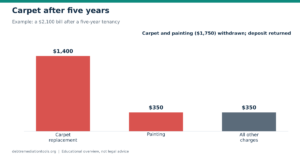
A hypothetical tenant receives a $2,100 bill after a five-year tenancy, including $1,400 for carpet replacement and $350 for painting. The landlord never provided a statement of condition or bank information for the deposit. She sends Letter 1 with move-out photos. The landlord withdraws the carpet and painting charges and returns her deposit after a local tenant attorney raises the c.186 § 15B issues.
Key Terms Defined
- Normal wear and tear: Expected deterioration from ordinary use.
- Security deposit: Money held by a landlord to cover unpaid rent or damage.
- Itemized statement: A detailed list of deductions with supporting evidence.
- Statement of condition: A document describing the unit’s condition at move-in.
- Tenant screening report: A consumer report used by landlords to evaluate applicants.
- Validation request: A written request for proof of a collection debt.
Quick-Use Checklist
- ☐ Each disputed charge listed with reason
- ☐ Photos and records attached
- ☐ Security deposit compliance reviewed
- ☐ Letter sent by certified mail
- ☐ Collector validation request sent within 30 days
- ☐ Credit and tenant screening reports checked
Common Mistakes to Avoid
- Disputing everything with no explanation. Address each charge specifically. It shows good faith and makes your strongest objections stand out.
- Missing the collector’s validation window. If the debt is in collections, send a written dispute within 30 days of the validation notice.
- Ignoring tenant screening reports. Rental debt can appear on tenant screening reports even if it isn’t on your credit report. Request your reports and dispute errors.
- Not saving move-out evidence. For future rentals, take dated photos and video at move-in and move-out.
Your Rental Debt Timeline
| When | Action |
|---|---|
| Within 30 days of move-out | Check whether the deposit and an itemized list were returned |
| When you receive charges | Send Letter 1 to the landlord |
| Within 30 days of a collector’s notice | Send Letter 2 |
| 30 to 45 days later | Check credit and tenant screening reports |
| If unresolved | Consult a tenant attorney or consider small claims |
Frequently Asked Questions
Use other evidence, such as witnesses, receipts, emails, or the landlord’s own records.
Usually not for normal repainting after a long tenancy. It depends on the condition and duration.
Yes. That is why disputing inaccurate charges matters.
Statutes of limitations for written contracts apply and vary by state. In Massachusetts, it is generally six years.
Small claims can be used to recover a security deposit or defend against charges. See our guide to small claims.
Sources and Further Reading
- Massachusetts General Laws Chapter 186, § 15B (security deposits)
- Massachusetts Attorney General, “Guide to Landlord and Tenant Rights”
- Fair Credit Reporting Act, 15 U.S.C. § 1681i
- Consumer Financial Protection Bureau, tenant screening resources
Don’t Pay for Wear and Tear
Debt Remediation Tools from Foxboro Consulting Group, Inc. includes both letters, a move-out photo checklist, and a security deposit compliance worksheet.
Got a move-out bill you don’t agree with? Send your dispute letter this week.
Disclaimer: Templates and tools in this article are provided for general educational purposes and are not legal advice. Adapt every letter to your own facts, keep copies of everything you send, and consult a licensed attorney in your state before responding to a lawsuit or court deadline.