

By the Debt Remediation Tools Team, Foxboro Consulting Group | Last updated: November 2026 | 5-minute read
Quick answer: A personal financial statement summarizes your monthly income, essential expenses, assets, and debts on one page. It helps you set realistic settlement offers and payment plans, supports hardship requests, prepares you for court payment hearings, and organizes information for credit counselors or bankruptcy attorneys. Share it selectively, only when required or helpful.
When you ask a creditor for help, negotiate a settlement, or attend a court payment hearing, you need clear numbers. How much do you earn? What must you pay to live? What do you own and owe? A personal financial statement answers these questions on one page, and it protects you from agreeing to payments you cannot sustain.
This guide provides a template, explains how to complete it, and covers when to share it.
Key Takeaways
- A personal financial statement lists income, expenses, assets, and debts.
- It helps you set realistic payment amounts before negotiating.
- Creditors may request financial information for hardship programs; courts may require it at payment hearings.
- Identify exempt income and assets, such as Social Security.
- Share only what is required, and keep the full statement for your own planning.
The Template
PERSONAL FINANCIAL STATEMENT
Name: ______________________ Date: __________
Household size: ____
MONTHLY INCOME (take-home)
Wages (after taxes): $______
Self-employment (net): $______
Social Security / SSI (exempt): $______
Pension / retirement: $______
Unemployment / disability: $______
Child support / alimony received: $______
Other: $______
TOTAL MONTHLY INCOME (A): $______
MONTHLY ESSENTIAL EXPENSES
Rent / mortgage: $______
Utilities (heat, electric, water): $______
Phone / internet: $______
Food: $______
Transportation (car payment, gas, insurance, transit): $______
Health insurance and medical costs: $______
Child care / child support paid: $______
Other necessary expenses: $______
TOTAL ESSENTIAL EXPENSES (B): $______
AVAILABLE FOR UNSECURED DEBTS (A – B): $______
ASSETS (estimated value)
Checking / savings: $______
Home (value) $______ less mortgage $______ = equity $______
Vehicle (value) $______ less loan $______ = equity $______
Retirement accounts: $______
Other assets: $______
DEBTS
Creditor | Balance | Monthly payment | Status
________ | $______ | $______ | ________
________ | $______ | $______ | ________
TOTAL DEBTS: $______
How to Complete It
- Use real numbers from the last three months of bank statements and pay stubs.
- Use take-home pay, not gross.
- Average irregular costs, such as car repairs or annual insurance, monthly.
- Mark exempt income such as Social Security, SSI, and VA benefits.
- List debts accurately, noting which are disputed or unverified.
How to Use It
| Purpose | How the statement helps |
|---|---|
| Settlement offers | Shows your maximum lump sum; see the negotiation script |
| Payment plans | Sets a sustainable monthly amount |
| Hardship requests | Supports your explanation with numbers |
| Court payment hearings | Organizes the information courts commonly request |
| Credit counseling | Speeds up budget review |
| Bankruptcy consultation | Prepares for means test discussions; see Chapter 7 means test |
| Your own planning | Feeds the 90-day debt action plan |
What to Share, and With Whom
- Creditors and collectors: Share only what they require for a specific program. A summary of income and expenses is often enough.
- Courts: Provide accurate information when ordered, and claim exemptions.
- Advisors you hire: Share the full statement.
- Never share account numbers or passwords unnecessarily.
Collectors are not entitled to your financial information simply because they ask. Providing it can help in hardship cases, but think before sending.
Example: The Number That Prevented a Bad Deal
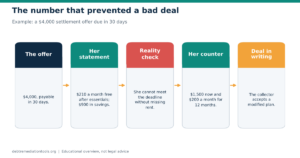
A hypothetical consumer is offered a settlement of $4,000 payable in 30 days. Her personal financial statement shows $210 per month available after essentials and $900 in savings. She realizes she cannot meet the deadline without missing rent. She counters with $1,500 now and $200 per month for 12 months. The collector accepts a modified plan in writing. Without the statement, she might have agreed to a deal she could not keep.
Key Terms Defined
- Personal financial statement: A summary of income, expenses, assets, and debts.
- Take-home pay: Income after taxes and required deductions.
- Exempt income: Income protected from most creditors, such as Social Security.
- Equity: The value of an asset minus any loan against it.
- Essential expenses: Costs needed for basic living and working.
- Payment hearing: A court hearing to set or review a payment schedule after judgment.
Quick-Use Checklist
- ☐ Three months of statements reviewed
- ☐ Take-home income totaled
- ☐ Essential expenses totaled
- ☐ Exempt income marked
- ☐ Assets and debts listed
- ☐ Available amount calculated
- ☐ Statement updated monthly
Common Mistakes to Avoid
- Guessing instead of checking. Use bank statements, not memory. Small expenses add up.
- Leaving out irregular costs. Car repairs, school costs, and annual bills should be averaged monthly.
- Listing exempt income without marking it. Make clear which income, such as Social Security, is protected from most creditors.
- Sharing the full statement with every collector. Share only what a specific program or court requires.
Update It Monthly
| Month | Income | Essential expenses | Available for debts | Change |
|---|---|---|---|---|
A statement that is a few months old can lead to offers you can no longer afford. Update it before every negotiation.
Frequently Asked Questions
Generally no, outside a court process. Share it when it helps you get relief, and only what is needed.
Use a three- to six-month average and note the variability.
Include household income for budgeting. For creditors, provide what is relevant to the debtor’s ability to pay, and get advice if unsure.
In post-judgment proceedings, courts may require financial disclosure. Provide accurate information.
Monthly, or whenever your income or expenses change.
Sources and Further Reading
- Consumer Financial Protection Bureau, budgeting worksheets
- Massachusetts Trial Court, supplementary process and payment review resources
- Official Bankruptcy Form 106I and 106J (income and expenses)
- 42 U.S.C. § 407 (protection of Social Security benefits)
Know Your Numbers First
Debt Remediation Tools from Foxboro Consulting Group, Inc. includes this statement in printable and spreadsheet form, connected to our budget and payoff tools.
About to negotiate or ask for help? Complete your statement first.
Disclaimer: Templates and tools in this article are provided for general educational purposes and are not legal advice. Adapt every letter to your own facts, keep copies of everything you send, and consult a licensed attorney in your state before responding to a lawsuit or court deadline.