

By the Debt Remediation Tools Team, Foxboro Consulting Group | Last updated: November 2026 | 5-minute read
Quick answer: To stop automatic withdrawals, send the lender or collector a written revocation of your ACH authorization and notify your bank to stop the recurring payments. Under federal rules, you can stop a preauthorized electronic transfer by notifying your bank at least three business days before the scheduled date; the bank may require written confirmation within 14 days. Revoking payments does not cancel the debt.
Automatic withdrawals are convenient until they are not. A payday lender drains your account the day your paycheck lands, a collector keeps debiting after you asked to stop, or a payment plan you can no longer afford triggers overdraft fees. Federal law gives you the right to stop preauthorized electronic transfers, but you need to act correctly and on time.
This guide provides a letter to revoke ACH authorization with the payee and a separate stop-payment notice to your bank.
Key Takeaways
- Revoke authorization with the payee (lender or collector) in writing.
- Notify your bank to stop recurring transfers at least three business days before the scheduled date.
- Your bank may require written confirmation within 14 days of an oral stop-payment request.
- Unauthorized debits after revocation can be disputed with your bank under Regulation E.
- Stopping payments does not erase the debt; arrange an alternative if the debt is valid.
Letter 1: Revocation to the Lender or Collector
[YOUR NAME]
[ADDRESS]
[DATE]
VIA CERTIFIED MAIL, RETURN RECEIPT REQUESTED [and email, if available]
[LENDER/COLLECTOR NAME AND ADDRESS]
Re: Revocation of authorization for electronic fund transfers
Account/loan number: [NUMBER]
Bank: [BANK NAME], account ending in [LAST FOUR]
To Whom It May Concern:
Effective immediately, I revoke any authorization I previously gave you or your agents to debit my bank account, by ACH or any other electronic or remotely created check method, for this account or any other account.
Please confirm in writing that you have cancelled all scheduled debits. Any debit initiated after you receive this letter is unauthorized.
[OPTIONAL: I will make payments by (method) under the arrangement described in my separate letter.]
Sincerely,
[SIGNATURE]
[PRINTED NAME]
Letter 2: Stop-Payment Notice to Your Bank
[YOUR NAME]
[ADDRESS]
[DATE]
[BANK NAME]
[BRANCH OR CUSTOMER SERVICE ADDRESS]
Re: Stop payment of preauthorized electronic transfers
Account number ending in: [LAST FOUR]
To Whom It May Concern:
Please stop all preauthorized electronic fund transfers from my account to the following payee(s):
Payee name as it appears on statements: [NAME]
Approximate amount(s): $[AMOUNT]
Next scheduled date: [DATE]
[Payee’s company ID, if shown on statement: (ID)]
I have revoked my authorization with the payee. Please block all future debits from this payee and notify me of any attempts. [This letter confirms my oral request made on (DATE).]
Sincerely,
[SIGNATURE]
[PRINTED NAME]
Timing Rules
| Step | Timing |
|---|---|
| Notify bank of stop payment | At least 3 business days before the scheduled transfer |
| Written confirmation (if bank requires) | Within 14 days of oral notice |
| Dispute unauthorized debit with bank | Promptly; Regulation E dispute rights depend on timely notice, generally within 60 days after the statement showing the transfer |
Banks may charge a stop-payment fee. Ask about fees and whether the bank can block the payee entirely.
If Debits Continue
- Report the unauthorized debit to your bank in writing and request reversal under Regulation E.
- Keep copies of your revocation and bank notices.
- File complaints with the CFPB and your state regulator.
- For payday lenders, check licensing; see payday loan debt help.
Credit Card Autopay
If the payee charges a credit card rather than a bank account, different rules apply. Contact the payee and your card issuer; billing error rights may help. See the credit card billing error dispute letter.
Paying Without Autopay
If you owe a valid debt, set up a payment method you control, such as mailing a check or making one-time online payments. Use the payment plan letter to put terms in writing.
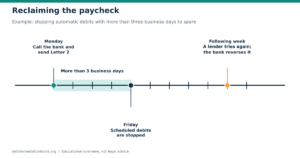
Example: Reclaiming the Paycheck
A hypothetical worker has two lenders debiting his account every payday, leaving too little for rent. He calls his bank on Monday, more than three business days before Friday’s scheduled debits, to stop payments, then sends Letter 2 the same day. He sends Letter 1 to each lender. One lender attempts a debit the following week; his bank reverses it as unauthorized after he submits a Regulation E dispute. He then sends a written payment proposal he can afford.
Key Terms Defined
- ACH (Automated Clearing House): The network used for electronic bank transfers.
- Preauthorized electronic fund transfer: A recurring transfer authorized in advance.
- Revocation of authorization: Withdrawing permission for future debits.
- Stop-payment order: An instruction to your bank to block specific transfers.
- Regulation E: The federal rule implementing the Electronic Fund Transfer Act.
- Remotely created check: A check created by a payee using account information, which may also need to be blocked.
Quick-Use Checklist
- ☐ Revocation letter sent to each payee
- ☐ Bank notified at least 3 business days before next debit
- ☐ Written confirmation sent to bank if required
- ☐ Statements monitored for further debits
- ☐ Unauthorized debits disputed promptly
- ☐ Alternative payment method arranged for valid debts
Common Mistakes to Avoid
- Telling only the lender. Revoke authorization with the payee and tell your bank. Doing just one leaves a gap.
- Missing the three-business-day window. Notify your bank at least three business days before the next scheduled debit.
- Closing the account without a plan. Closing an account may stop the debits but can cause problems with other automatic payments.
- Forgetting the debt. Stopping payments does not erase what you owe. Arrange a payment method you control for valid debts.
Monitor Your Account
- Check your account daily for two weeks after sending the letters.
- Record any attempted debit, with the date, amount, and payee name.
- Report any unauthorized debit to your bank in writing right away.
- Keep copies of both letters with proof of delivery.
Frequently Asked Questions
You have the right to revoke authorization and to stop preauthorized transfers through your bank, regardless of what the lender prefers.
Missed payments may be reported if you do not pay another way. Arrange an alternative payment if the debt is valid.
Many do. Ask in advance.
Give your bank all names that appear on statements, and ask about blocking the payee’s company ID.
Federal rules generally prohibit conditioning credit on preauthorized electronic transfers, with limited exceptions.
Sources and Further Reading
- Electronic Fund Transfer Act, 15 U.S.C. § 1693 et seq.
- Regulation E, 12 C.F.R. §§ 1005.10 (preauthorized transfers) and 1005.11 (error resolution)
- Consumer Financial Protection Bureau, “How do I stop automatic payments from my bank account?”
- Nacha Operating Rules (ACH network rules)
Take Back Control of Your Account
Debt Remediation Tools from Foxboro Consulting Group, Inc. includes both letters, a debit monitoring log, and Regulation E dispute templates.
Automatic withdrawals draining your account? Send both letters before the next scheduled debit.
Disclaimer: Templates and tools in this article are provided for general educational purposes and are not legal advice. Adapt every letter to your own facts, keep copies of everything you send, and consult a licensed attorney in your state before responding to a lawsuit or court deadline.